
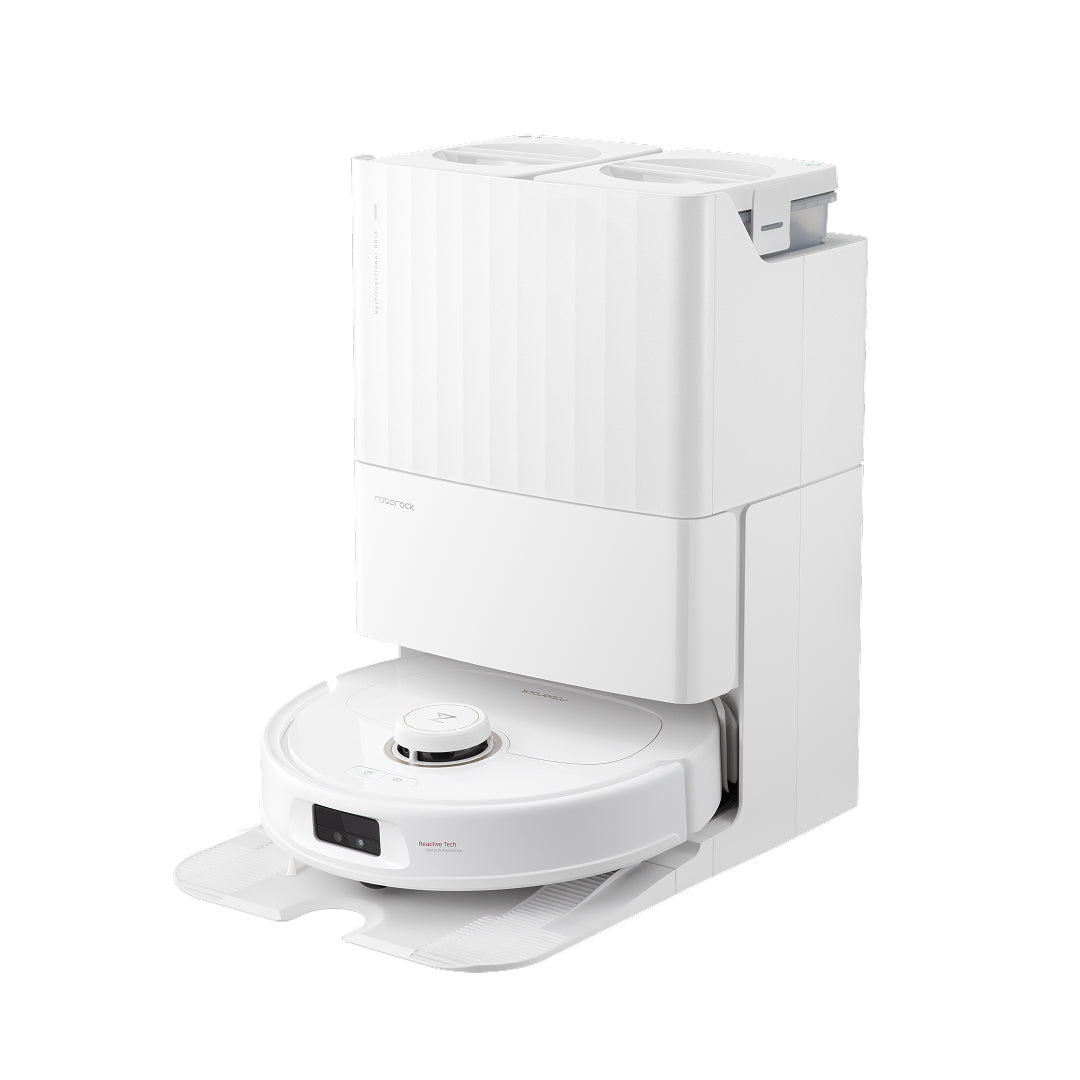
Your needs, this model
Does it fit your priorities?
Will this exact standard offer meet a 7,000 Pa manufacturer-listed suction minimum?
Roborock lists 7,000 Pa for this offer under its stated internal test condition; it is not an independent pickup score.
Explore this need in the finder →Does the dock publish a 140°F (about 60°C) mop-wash claim?
Yes. The exact U.S. page lists 140°F hot-water pad washing in the dock; that does not mean hot water is supplied to the floor.
Explore this need in the finder →Can the app connect if a 2.4-GHz Wi-Fi network is available?
Yes. The exact Qrevo MaxV FCC/IC manual states that Wi-Fi is 2.4 GHz only; 5 GHz is not supported.
Explore this need in the finder →Does the standard model publish a typical battery rating of at least 5,000 mAh?
Yes. The model-specific manual lists a typical 5,200-mAh battery; this is not a runtime or floor-area promise.
Explore this need in the finder →Does it supply warm water to the floor during mopping?
No such feature is confirmed. Dock pad washing is heated, but the exact manual says not to put hot water in the robot tank.
Explore this need in the finder →Does the exact offer publish a supported maximum high-pile carpet height?
No. The manual describes mop retraction on carpet, but neither source gives a supported high-pile height.
Explore this need in the finder →Will the nominal 4.01-inch third dimension fit under a 4.25-inch opening?
The source lists 13.78 × 13.9 × 4.01 inches without axis labels; the final value is a nominal height only, not guaranteed furniture clearance.
Explore this need in the finder →Does an exact source give a numeric maximum threshold-crossing claim?
No. The exact U.S. product page and manual do not publish a numeric threshold-crossing limit.
Explore this need in the finder →Does the exact package pair dual spinning pads with automatic dock washing and drying?
Yes. The exact U.S. offer lists dual spinning mop modules and a dock that washes and dries them; the owner still services removable tanks and the tray.
Explore this need in the finder →This review covers Roborock’s standard U.S. Qrevo MaxV listing, product 7120746807414, sold under the single Default Title variant RR-QRevoMaxV0-M1. It is the Multifunctional Dock 2.0 package, not a refill-and-drainage installation. The native listing is currently unavailable; its page says “out of stock, coming soon” and also carries a “not launched yet” notice. Treat this as a model assessment, not a statement that a new unit can be ordered today.
What the robot and dock are designed to do
The Qrevo MaxV combines LiDAR mapping, an all-rubber main brush, dual rotating mop pads and a small extending edge-mop arm. Roborock lists maximum suction at 7,000 Pa, pad rotation up to 200 rpm in an internal test at extreme water flow, and 30 selectable water-flow levels. Those are manufacturer specifications, not independent pickup or stain-removal results. They help describe the design, but they do not tell you how well this robot handles a particular pile of pet hair, a dried spill or a rug edge in your rooms.
The multifunctional station adds automatic dust emptying, mop washing, warm-air drying and robot-tank refilling. Its mop wash is advertised at 140°F (about 60°C), and warm-air drying at 113°F (about 45°C). Roborock says the station can check dirt and repeat a mop wash; the automatic re-mop feature must be enabled in the app. A claimed bag interval of more than seven weeks is a maker capacity statement, not a guaranteed service interval. A shedding pet, larger floor area or frequent cleaning can change how often the bag needs replacement.
Automation still leaves a practical dock routine
This is a removable-tank station, not a no-touch water connection. The manual shows clean- and dirty-water reservoirs, a cleaning tray and a disposable dust bag. You still carry the clean tank to fill it, empty dirty water, replace the bag, and rinse the tray when needed. Hot water is for washing pads in the station; the manual says not to put hot water in the robot’s clean-water tank. The station does not make the robot mop your floor with heated water.
Check the floor-space drawing as well as the listed dock body. The product page gives robot dimensions of 13.78 × 13.9 × 4.01 inches and dock dimensions of 13.38 × 19.17 × 20.51 inches, but it does not label the dimension axes. The manual asks for an open installation area with roughly 0.9 m overhead clearance, 0.4 m of side space and 1.2 m in front. Keep the station on a hard, flat floor; the instructions warn that a mat or carpet under the dock can interfere with docking.
Carpet choices and obstacle sensing have limits
The robot can lift its brushes and mop assembly and retract the mop mount when it detects carpet. The product page offers carpet-first, deep-clean and avoidance settings. This is useful for mixed floors when you are willing to set the route and observe a first run, but it is not a published carpet-pile rating. The exact U.S. materials give no supported high-pile height, so do not use “mop lifting” as proof that a thick rug is a safe match.
Reactive AI obstacle recognition uses structured light and an RGB camera. Roborock reports recognition of 62 object types in 20 categories in internal tests and supports live viewing and two-way voice. This may reduce some small-item encounters; it does not promise that every cord, pet accident or toy will be avoided. Pick up loose cables and valuables, supervise the first complete route and keep the camera features disabled if you do not want remote viewing in the home.
Network, power and upkeep
The model-specific manual identifies the robot as QR0PEP and lists EWFD16LRR and EWFD20LRR as supported docks. The U.S. product listing does not bind its box to one of those suffixes, so check the dock label if you need replacement compatibility. The manual calls for a grounded nominal 120-V, 60-Hz outlet and only 2.4-GHz Wi-Fi. A 5-GHz-only router is not a confirmed app setup. Roborock’s “Hello Rocky” voice assistant can start basic jobs without Wi-Fi, but app mapping, scheduling and other connected controls depend on a supported network.
Routine care includes cleaning brushes, sensors, wheel, mop cloths, filter and the dock’s tanks and tray. After rinsing the washable filter, let it dry thoroughly before reinstalling. The robot is a poor fit if you require a numerical threshold-crossing limit, a published high-pile carpet rating, warm water on the floor, a fixed-plumbed dock or 5-GHz-only connectivity. The exact materials do not establish those requirements.
Who should keep it on a shortlist
Consider this design if you specifically want spinning-pad mopping with automatic dust emptying, pad washing and drying, tank refill and an edge-reaching mop, and your home has mostly hard flooring or manageable low/medium rugs. It is less persuasive if your priority is a low-clearance body: the published final dimension is about four inches and the axes are not labeled. Compare the lower-profile Qrevo Slim only if its separate size and dock requirements suit your rooms; compare QV 35S if you want to evaluate a different station and obstacle-sensing arrangement. These are not interchangeable packages. Verify the exact SKU, included dock code, return terms and current seller status before purchase. No current price or orderability is asserted here.
Source trail
Assessment based on Roborock’s U.S. Qrevo MaxV product page and its model-specific FCC/IC manual. Numeric cleaning and avoidance claims above are identified as manufacturer statements rather than independent test results.
Key details at a glance
| Manufacturer-listed maximum suction | 7000 Pa |
|---|---|
| Robot height | 4.01 in |
| Manufacturer-reported dock dimension sequence (axes unspecified) | 13.38 × 19.17 × 20.51 inches (exact U.S. page sequence, axes unlabeled). |
| Published dock mop-cleaning temperature claim | 60 °C |
| Battery capacity | 5200 mAh |
| Mop system | Dual spinning or rotating mop pads |
| Warm water supplied for the robot's mop cycle | No |
| Manufacturer-listed object-recognition types | 62 types |
| 2.4 GHz Wi-Fi supported | Yes |
| 5 GHz Wi-Fi supported | No |
| Dock water hookup | Removable dock water tanks |
| Fixed water supply and drain required | No |
| Dock empties dust automatically | Yes |
| Maximum manufacturer-claimed base dust capacity window | 49 days |
Use the exact model’s instructions for operating limits, supplied equipment and version differences.
Sources for this assessment
Check the fit before choosing the dock.
Compare your furniture clearance, network, floors and the work the station still asks you to do.