
Your needs, this model
Does it fit your priorities?
Does a 30,000 Pa manufacturer suction specification meet your minimum?
The exact T2081111 page lists 30,000 Pa; this is a manufacturer figure, not a pickup test.
Explore this need in the finder →Do you need the separately qualified double-layer threshold mode?
The page distinguishes a 4.2 cm double-layer claim from a 3.5 cm single-layer claim; the larger figure depends on geometry.
Explore this need in the finder →Do you need an explicit manufacturer carpet-pile limit?
The page claims carpet cleaning up to two inches and its FAQ lists avoidance/caution conditions; that is not a route guarantee.
Explore this need in the finder →Which Wi-Fi band is available where the dock will be used?
The T2081 guide lists 2.4 GHz only; 5 GHz-only setup is not confirmed.
Explore this need in the finder →Can your home support a removable-tank dock instead of fixed plumbing?
Standalone SKU T2081111 uses the guide-listed removable clean/dirty tanks; the separate refill-and-drain package is a different option.
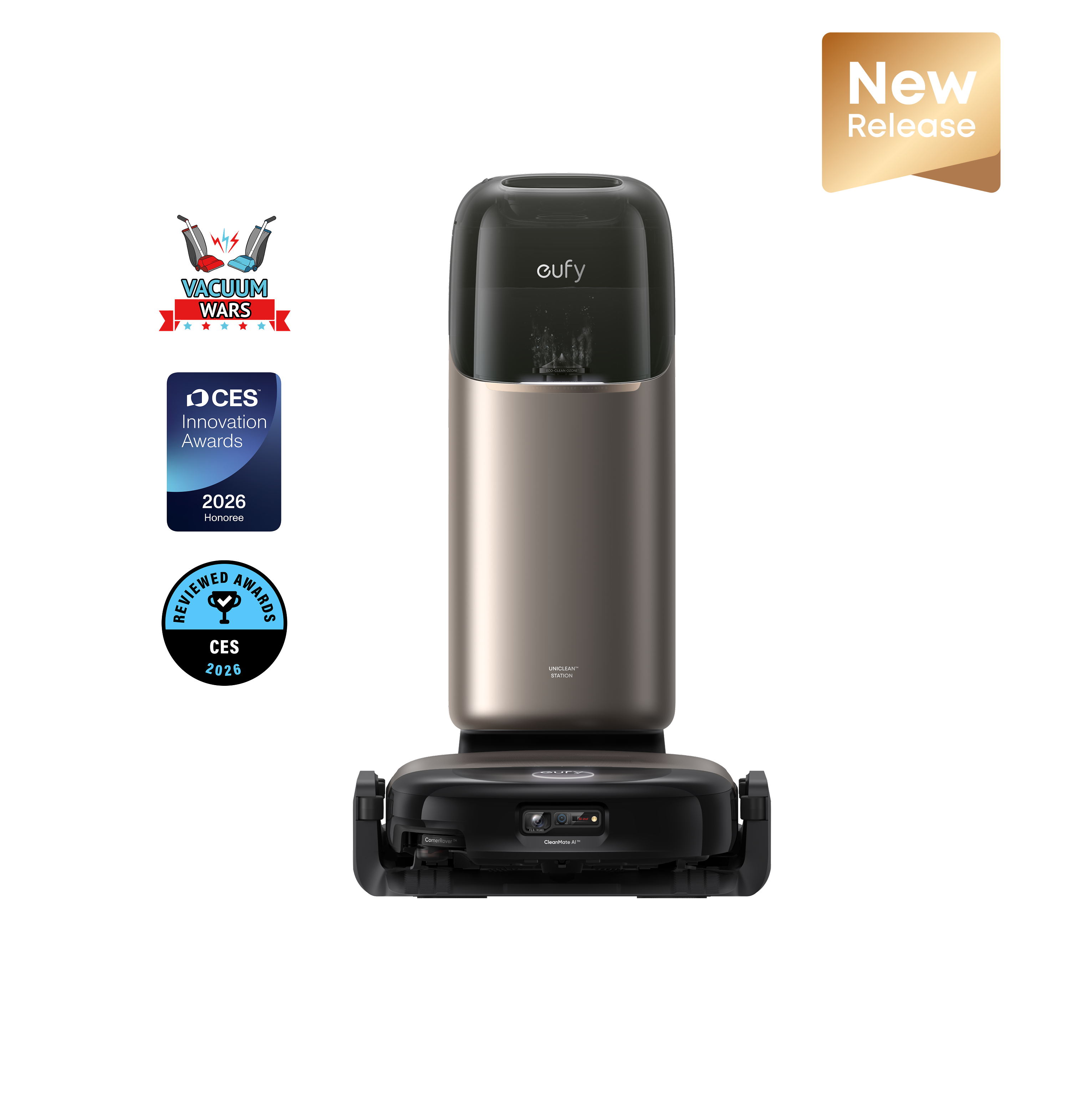
Explore this need in the finder →The eufy Robot Vacuum Omni S2, SKU T2081111, pairs a vacuum-and-mop robot with an Omni station. This assessment is for the standard removable-tank station package—not the separately listed Auto Refill and Drainage System bundle, and not the older S1 Pro T2080. That distinction matters: the exact S2 product page displays a separate plumbing-package option, while the T2081 guide describes removable clean- and dirty-water tanks for the base station.
A roller system with a more specific carpet and threshold claim
HydroJet 2.0 is a self-cleaning roller that the maker says refreshes during cleaning. The product page lists 15 N of downward pressure, 240 rpm, electrolyzed water, and 30,000 Pa suction. Those are manufacturer specifications and feature claims, not an independent cleaning comparison or a measured household result. The listed 30,000 Pa figure sits below the E35's advertised 35,000 Pa and above the C28's 15,000 Pa; that ordering does not by itself tell you which robot picks up more debris.
The S2's product page says it can cross a single-layer threshold up to 3.5 cm and a qualified double-layer threshold up to 4.2 cm. Treat those as two different claims. The larger figure depends on threshold geometry and is not evidence that the robot can cross an ordinary 4.2 cm step. Surface, rise shape, gap, approach, and route can all change whether a machine makes it through. If a room transition is an essential constraint, measure its full profile and compare it with the manufacturer's stated condition rather than using the biggest number as a guarantee.
Carpet is another area where the S2 is more explicitly described than some nearby models. eufy lists carpet cleaning up to 2 inches, automatic suction/height adjustment, and mop lifting. Its FAQ says to use vacuum-only mode on short or medium pile, avoid tassels, and use carpet-avoidance mode for thick carpets over 5 cm. Dark carpet may not be detected accurately, and the FAQ recommends no-go zones in doubtful areas. This is a maker limit, not independent evidence that every rug below the claimed height will be handled. If your rugs are tasselled, unusually soft, dark, or right at the limit, plan to exclude them or test the route under supervision.
The dock reduces chores, not all maintenance
The 12-in-1 UniClean station is described as emptying dust, washing and drying the roller, disinfecting, dispensing detergent, and holding dust for a stated period. The T2081 guide's specifications list a 3 L clean-water tank, a 2 L dirty-water tank, and a 2.5 L dust bag. It also lists 120 ml and 150 ml onboard clean- and dirty-water reservoirs. Because the base plan uses removable tanks, you still carry clean water, empty wastewater, replace the bag, and clean the roller, dirty-water tank, filter tray, and other parts. The guide gives use-dependent maintenance intervals, including dirty-water reservoir service every 30 operating hours, filter-tray service every 30 hours, and roller replacement every 180 hours. “Hands-free” should not be read as maintenance-free.
The product page describes electrolyzed water and sterilization claims, but neither that wording nor the guide publishes a numeric temperature for water reaching the floor during mopping. Do not translate a sanitation headline into a warm-water-mopping temperature. The guide also warns against vacuuming large amounts of water; this is a robot vacuum/mop, not a wet/dry spill machine. Although the guide's stated routines include vacuum-only and vacuum-and-mop, it does not establish a separate mop-only mode.
Questions that change whether it fits
The included app and mapping setup require a 2.4 GHz Wi-Fi signal; the T2081 specification lists the 2.4 GHz band only. A 5 GHz-only network is therefore not a confirmed match. The product page advertises 3D MatrixEye 2.0 obstacle recognition for more than 200 types. That count is a manufacturer claim, not a guarantee that it will recognize or avoid every cable, sock, furniture leg, or reflective surface. eufy's FAQ itself recommends clearing small objects, wiping sensors, and using no-go zones where recognition may be unreliable.
The guide gives robot and station dimensions as ordered millimeter sequences without naming the axis labels. Do not assume the final robot dimension is a verified height for furniture-clearance matching; measure the robot and gap, and leave extra room for movement. The station also needs a sensible placement, power, and access for lifting its tanks. For a no-plumbing home, select the standalone T2081111 tank package; the distinct T210L110 package requires a suitable fixed supply, drain and installation path. Compare the T210L110 water-service configuration before choosing.
Who should compare it with the C28 or E35?
The S2 is a plausible candidate for a hard-floor home with some manageable carpets, a 2.4 GHz network, and a preference for a powered roller and tank-based station. Its stronger case over the E35 is the combination of stated carpet and threshold limits and the 4.2 cm double-layer claim—not the highest suction number. Compare the E35 if its higher listed suction and more detailed roller dimensions matter more, while accepting that its reviewed exact sources leave carpet-pile and threshold maxima unknown. Compare the C28 if its own 2 cm threshold statement and lower advertised suction fit the route and routine; its manual warns against high-pile rugs or rugs over 18 mm. The three are not interchangeable: choices about pile height, threshold shape, dock plumbing, mop mode, network band, and service chores can change the shortlist.
Choose a different model if you require a confirmed warm-water floor-mop temperature, reliable cleaning on tasselled or very thick rugs, a stated furniture-clearance height, a 5 GHz-only connection, or verified spill cleanup. The S2's specifications make it easy to identify what to ask about, but they do not settle those unresolved requirements for your specific home.
Key details at a glance
| Manufacturer-listed maximum suction | 30000 Pa |
|---|---|
| Robot weight | 11.46 lb |
| Maximum manufacturer-listed threshold claim | 3.5 cm |
| Battery capacity | 4600 mAh |
| Mop system | Real-time refreshed roller mop |
| Dock clean-water tank | 3 L |
| Dock dirty-water tank | 2 L |
| Manufacturer-listed object-recognition types | 200 types |
| 2.4 GHz Wi-Fi supported | Yes |
| 5 GHz Wi-Fi supported | No |
| Manufacturer carpet-pile support claim | Yes |
| Maximum manufacturer-listed carpet pile | 2 in |
| Dock water hookup | Removable dock water tanks |
| Fixed water supply and drain required | No |
| Dock empties dust automatically | Yes |
| Conditional two-step threshold claim | 4.2 cm |
Use the exact model’s instructions for operating limits, supplied equipment and version differences.
Sources for this assessment
Check the fit before choosing the dock.
Compare your furniture clearance, network, floors and the work the station still asks you to do.