
Your needs, this model
Does it fit your priorities?
Do you want a vacuum-only robot rather than a machine that also wets floors?
The RV2310AE package is vacuum-only; the exact offer does not include a mop pad, water tank or mop-care arrangement.
Explore this need in the finder →Is an included automatic dust-emptying base essential?
Shark includes a bagless Self-Empty Base that empties robot dust after each clean. The base still needs eventual service and is advertised for up to 45 days of capacity.
Explore this need in the finder →What minimum published base-capacity claim would be useful to you?
Shark states up to 45 days for the base. Treat that as a capacity claim rather than a promise that your household can wait 45 days between emptying.
Explore this need in the finder →Does your SharkClean app setup have access to 2.4-GHz Wi-Fi?
The Shark Matrix 2300-series guide states the app works only on 2.4-GHz Wi-Fi. It also describes basic cleaning from robot buttons, but schedules are app-only; this is a family-level guide rather than an RV2310AE code printed on the cover.
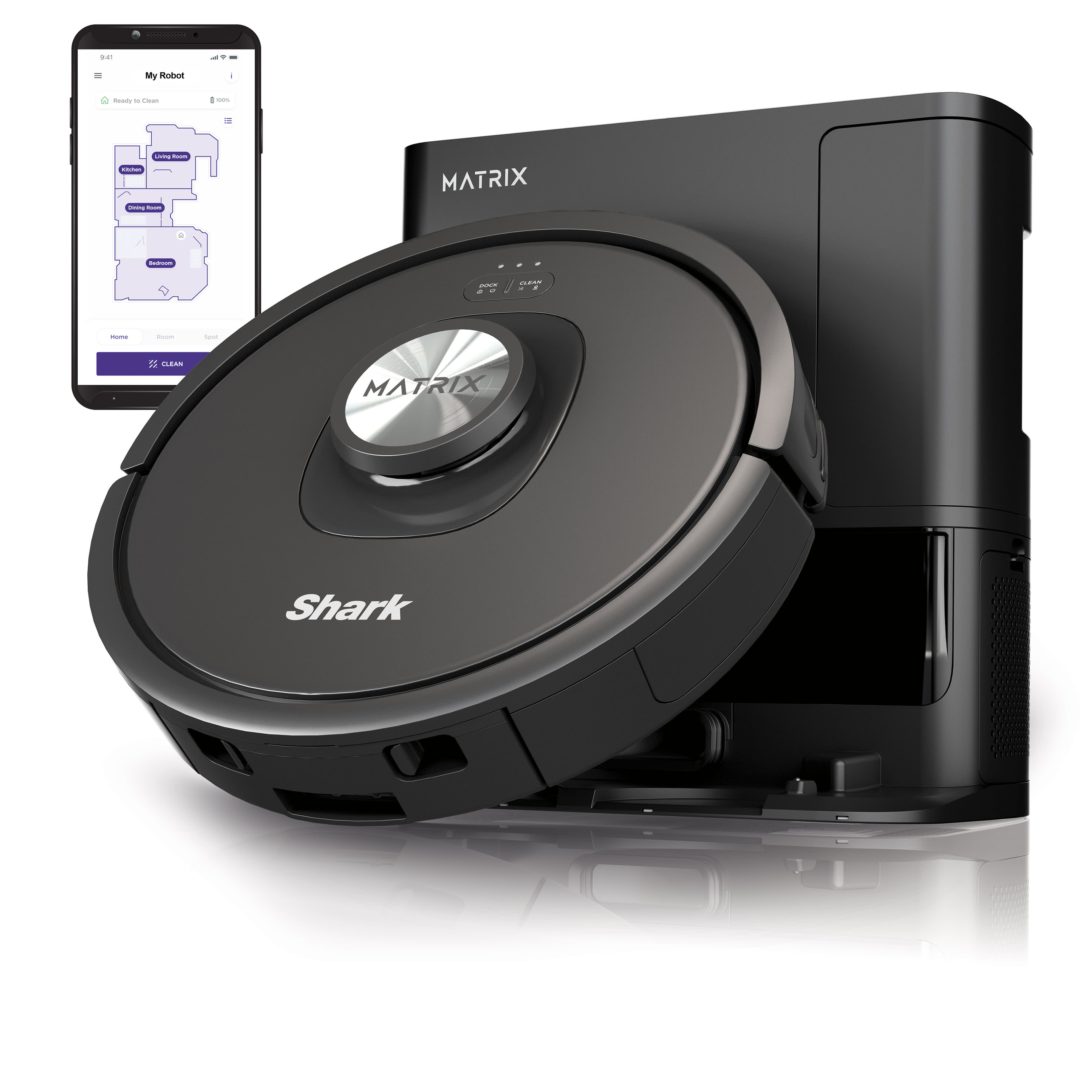
Explore this need in the finder →The Shark Matrix Robot Vacuum RV2310AE is the dry-vacuum version in this Matrix family: its exact U.S. offer describes vacuuming, mapping and an included dust-emptying base, but no mop pad or water system. That matters if you want scheduled floor pickup without adding a refill-and-wash routine. It is also different from the Matrix Plus RV2610WA, which adds a sonic mop. The RV2310AE's appeal is the simpler job, not a promise that one robot handles every kind of floor care.
What the Matrix name means in this package
Shark describes Matrix Clean as a precision grid that makes multiple passes over dirt, and says the robot uses 360-degree LiDAR to build a home map. In the SharkClean app, the manufacturer says you can choose areas for cleaning, run targeted Matrix cleans and set schedules. Those controls suit someone who wants a room-focused routine instead of pressing a button and hoping a random route revisits a missed patch. They remain manufacturer descriptions, not an independent coverage test: furniture changes, loose cords and floor clutter can still affect a run, and object-detection language should not be treated as a guarantee that every small item will be avoided.
The base reduces one chore, but does not make the robot maintenance-free
The exact offer includes a bagless Self-Empty Base. Shark says the base empties after cleaning, holds up to 45 days of dirt and debris, and needs no disposable dust bag. That is a useful difference from a charging-only robot or a dock that depends on proprietary bags. But “up to 45 days” is a capacity claim, not a reliable interval for every home. Pet hair, dust, run frequency and floor area all change how quickly the base fills, so plan to check it rather than assuming you will not touch it for six weeks.
The robot itself has a listed 0.2-quart dust cup. Auto-empty transfers that debris to the base; it does not eliminate filter and brush care. Shark calls the brushroll self-cleaning and anti-hair-wrap, a welcome design goal if hair is common in your home, but not proof of zero tangles or a measured pet-hair pickup result. The offer also lists a washable pre-motor filter that should be cleaned with cold water only. The included box list names the robot, base and one side brush. Treat the service routine as lighter, not absent.
Check fit, network, and setup constraints before choosing
Shark lists a 5.7-inch cleaning path, 90-minute battery-life claim and six-hour charge time. Those are maker specifications rather than runtime or route measurements in a household. The page also lists overall product dimensions of 15.24 by 10.91 by 17.28 inches, but does not identify whether they describe the robot, base or complete arrangement. A separate Shark-hosted page result for this model displays a different robot-sized dimension set. Because those contexts are not reconciled, do not use either number set to promise clearance beneath a sofa; request the robot-only height if low furniture is a hard requirement.
A Shark Matrix 2300-series Owner's Guide adds an important network and setup distinction. It says SharkClean app functions use a 2.4-GHz network and that scheduling is handled in the app; the guide also describes starting a whole-home or targeted clean with the robot's buttons. So a household with only 5-GHz Wi-Fi should not count on this configuration for app scheduling, even though manual button cleaning is described. The guide is labeled for the 2300 series rather than printing RV2310AE on its cover, so treat that as family-level setup evidence, not a guarantee for every bundle or software state.
The same guide recommends a fixed, level dock location on bare floor, with three feet clear on either side and five feet in front. It advises blocking thresholds 0.75 inch or higher with a no-go zone and keeping rugs at least eight inches from stairs. Those are placement and safety directions, not a measured promise that the robot climbs any threshold below that figure. If an exact body-height or threshold-crossing limit is essential, the product listing still does not settle it.
Compare the dry Matrix with the two Shark alternatives by routine
Choose RV2310AE over the Matrix Plus RV2610WA when you want dust auto-emptying and mapped vacuuming but do not plan to mop. The Plus adds a sonic pad and water handling; those features make sense only if you will fill, attach and clean the mop equipment. The Navigator RV2120AE is another vacuum-only mapped Shark with an included bagless base, but Shark advertises up to 60 days of base capacity for that package versus 45 days for RV2310AE. These are different manufacturer capacity claims, not guaranteed time between emptying, and the exact model's other dimensions and features still need their own checks.
The RV2310AE is most compelling for a household that values targeted mapped vacuuming and wants to avoid dust bags, while accepting that the base and robot still need periodic attention. It is a poor match if you require mopping, verified robot height, a published threshold-crossing rating, app scheduling on a 5-GHz-only network, or a longer stated base-capacity window. The 2.4-GHz app detail comes from a 2300-series guide rather than a cover-printed RV2310AE manual. The exact product listing also showed a back-in-stock notification prompt alongside selection and price controls when checked, so availability was not clear enough to promise. Search by the full model code rather than assuming any similarly named Matrix robot or replacement base is the same package.
Key details at a glance
| Mop system | Vacuum-only; no mop system |
|---|---|
| 2.4 GHz Wi-Fi supported | Yes |
| 5 GHz Wi-Fi supported | No |
| Dock empties dust automatically | Yes |
| Maximum manufacturer-claimed base dust capacity window | 45 days |
Use the exact model’s instructions for operating limits, supplied equipment and version differences.
Sources for this assessment
- SharkNinja U.S. exact RV2310AE product offer
- SharkNinja U.S. robot-vacuum directory observation
- SharkNinja support route linked from the exact RV2310AE offer
- SharkNinja image host, RV2310AE model-coded lead product render
- SharkNinja support FAQ destination opened in browser
- CPSC recall index exact-code search for RV2310AE
- Shark Matrix Robot Vacuum 2300 Owner's Guide (SharkNinja-authored; Home Depot-hosted PDF)
- SharkNinja U.S. replacement base model XDRV2310AE compatibility page

Check the fit before choosing the dock.
Compare your furniture clearance, network, floors and the work the station still asks you to do.