
Your needs, this model
Does it fit your priorities?
Does the exact U.S. page describe a sonic mopping pad rather than spinning pads or a roller?
Yes. Shark calls RV2610WA Sonic Mopping and states up to 100 scrubs per minute. This describes the manufacturer-claimed mechanism, not an independent stain-removal result.
Explore this need in the finder →Will the app connect if the home has only a 5GHz Wi-Fi network?
No. The RV2600WA Series guide says the app works only on 2.4GHz Wi-Fi; basic physical CLEAN/DOCK operation is documented, but the app's mapping and zone controls need 2.4GHz.
Explore this need in the finder →Does the included base wash and dry the mop pad after a run?
No. The base empties dry debris; the owner removes the reservoir bin, empties remaining fluid and debris, and cleans and dries the reusable pad and bin.
Explore this need in the finder →Does the manual certify the robot for high-pile carpet while mopping?
No numeric high-pile limit or approval appears in the inspected family guide. It says remove rugs or set and verify Carpet Zones for mopping, so an essential high-pile requirement is unknown and does not qualify.
Explore this need in the finder →Does the manual give a maximum threshold height for this exact robot?
No. It says the robot can cross most thresholds but gives no numeric maximum for RV2610WA, so a route-specific numeric threshold requirement remains unconfirmed.
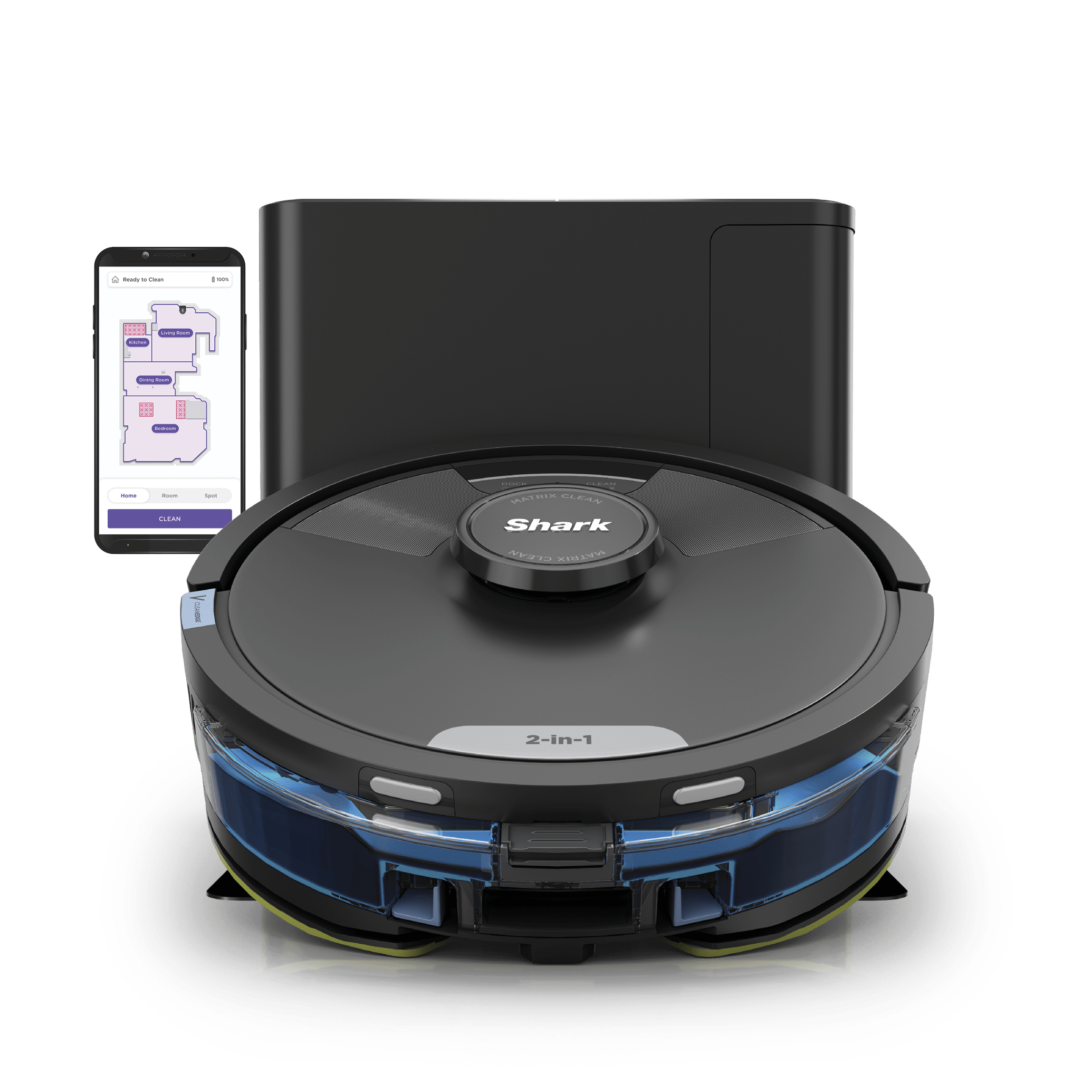
Explore this need in the finder →The Shark Matrix Plus 2-in-1 Robot Vacuum and Mop, model RV2610WA, combines a mapped vacuum, bagless dust-emptying base and a removable sonic-mopping pad. It suits a home that wants daily dry pickup plus occasional hard-floor mopping and is willing to refill and clean that mop hardware by hand. It is not a self-washing mop station: the included XL base empties dust, while you handle the water reservoir and washable pad. Shark's current U.S. product page marked this exact model out of stock when checked on October 23, 2026; the model remains documented here, but stock can change.
The sonic mop is a pad you maintain, not a dock-cleaned roller
Shark describes the RV2610WA's Sonic Mopping as scrubbing hard floors up to 100 times a minute. That is the maker's feature specification, not a lab result or proof that it removes every dried stain. The guide shows a microfiber pad on a plate attached to the combined Vac & Mop dust bin, which also contains a water reservoir. The robot can vacuum alone or vacuum and mop at once; the guide documents no mop-only mode.
Unlike a roller or spinning-pad robot, this one does not return to a dock to wash the pad, refill water or dry it. Fill the onboard reservoir, add the manufacturer's recommended VACMOP solution as directed, attach the pad plate and run the combined mode. Afterward, remove the bin, empty remaining liquid and debris, wash the pad and let the bin dry fully before storage. Shark cautions that a freshly mopped floor can be slippery and tells owners not to use the robot to pick up liquid spills or on a wet surface. Do not treat a floor-mopping function as wet/dry spill pickup.
The base reduces dust-bin trips but keeps the rest of the routine
The included XL HEPA Self-Empty Base collects dry debris automatically, and Shark describes it as bagless, so the owner avoids buying a disposable dock bag. The product page promotes up to 60 days of dust capacity; the RV2600WA-series guide says to empty the base every 30 to 60 days depending on base size or sooner as needed. Use the fill line and actual household debris as your guide rather than assuming a fixed two-month interval.
There is still filter and brush care. The guide asks owners to tap the robot's self-empty-bin filter after emptying, clean the base's pre-motor filters monthly, and replace filters as they wear. The mop reservoir/bin must be emptied after a mopping run, wiped and allowed to air-dry; the pad should be washed and dried between uses. This is more hands-on than an auto-washing dock, but less complicated than installing water lines or servicing wastewater tanks. The exact product page's included side-brush count is inconsistent between two sections, so verify that small part in your carton rather than relying on a duplicated online list.
Mapping and carpet choices require setup
The product page describes 360-degree LiDAR mapping, a SharkClean app map, schedules, room selection and no-go zones. The manual documents an initial Explore Run and says to clear small objects under 4.5 inches so they do not disrupt that run. It also tells owners to create no-go zones near risky boundaries and check that the boundary actually prevents entry. Shark claims object detection and avoidance, but that is not a promise that it will reliably identify every cable, toy or pet mess.
For mopping across mixed flooring, the manual requires the pad-free Explore Run first and recommends setting Carpet Zones followed by a Carpet Verification Run. It also says to remove rugs or mats from the path before the first mopping run. The sources reviewed do not publish a supported high-pile maximum, so a high-pile carpet requirement is unknown, not a pass. The manual provides no numeric threshold limit either; its statement that the robot climbs “most” thresholds is not a measurement for your doorway. And the two published runtime figures disagree: the product page lists 110 minutes, while the series guide says 60 minutes expected. Neither is a measured guarantee, so plan around your floor area rather than treating either as a tested whole-home result.
Check the Wi-Fi and the station footprint
The app guide requires 2.4GHz Wi-Fi; it does not list 5GHz-only setup. Physical CLEAN and DOCK controls are documented, but if your routine relies on room maps, schedules, no-go zones or carpet verification, treat a compatible 2.4GHz network as essential. Measure the base location and route yourself. The sources reviewed do not give an unambiguous robot-height figure or a dock service code for this exact package, so do not infer furniture clearance or replacement-base compatibility from a product photograph.
Shark calls the base HEPA and states a 99.97% filtration figure down to 0.3 microns. That remains a manufacturer claim, not an independent filtration test or a medical outcome. Matrix grid, CleanEdge and carpet-cleaning comparisons likewise describe intended behavior, not tested pickup in your rooms.
Who should consider the RV2610WA?
Choose it if you want LiDAR mapping, dry-dust auto-emptying, a bagless base and a sonic pad you can wash yourself—not a hands-off wash station. The questionnaire should include it when sonic mopping or automatic dust emptying is essential; it should withhold it for 5GHz-only app setups, a required auto-washing dock, warm-water floor mopping, a published high-pile limit or a numeric threshold claim.
Compare the maintenance plan before choosing by feature name alone. The reviewed eufy Omni C28 uses a refreshed roller and a tank-and-wash station, trading less pad handling for water-tank, wastewater and roller care. A flat-cloth alternative such as a Roomba 105 Combo has a different mop and dock routine. If mopping is not necessary, compare a vacuum-only configuration instead. None of those differences is a universal performance ranking: match the mechanism, floor mix, Wi-Fi and maintenance you can actually support.
Key details at a glance
| Mop system | Sonic single reusable mop pad |
|---|---|
| 2.4 GHz Wi-Fi supported | Yes |
| 5 GHz Wi-Fi supported | No |
| Dock water hookup | Dust-empty dock; no dock water service |
| Fixed water supply and drain required | No |
| Dock empties dust automatically | Yes |
| Maximum manufacturer-claimed base dust capacity window | 60 days |
Use the exact model’s instructions for operating limits, supplied equipment and version differences.
Sources for this assessment
- SharkNinja U.S. exact RV2610WA product page
- SharkNinja U.S. robot-vacuum catalogue, observed listing page
- SharkNinja support route linked from exact RV2610WA product page; RV2600WA Series
- Shark Customer Service official Manuals index
- Shark RV2600WA Series Matrix Plus 2-in-1 Owner's Guide (manufacturer-authored manual, viewed at ManualsLib mirror)
- CPSC recall index, exact-name searches for Shark RV2610WA and Matrix Plus RV2610WA
Check the fit before choosing the dock.
Compare your furniture clearance, network, floors and the work the station still asks you to do.