
Your needs, this model
Does it fit your priorities?
Will the Saros Z70 move small light items out of its route?
Roborock currently names socks, sandals, crumpled tissues and towels under 300g for its app-configured arm. It is disabled by default; do not treat it as a general-purpose picker or leave hazards and fragile items down.
Explore this need in the finder →Does the Saros Z70’s 108-object recognition count mean it can move 108 different things?
No. The 108 figure describes obstacle types its navigation system may recognize. Roborock separately names four currently organized item classes for the arm, with the towel weight under 300g.
Explore this need in the finder →Is the gripper rated for objects heavier than 0.3kg?
No. The US manual lists a 0.3kg rated load and warns not to exceed it. The arm is not a substitute for moving fragile, hazardous or valuable items yourself.
Explore this need in the finder →Will a 3.5-inch measured opening clear the Saros Z70 body?
Its listed height is 3.14 inches, but a nominal 3.5-inch gap leaves little tolerance for a rug edge or uneven floor. Measure the complete route rather than assuming a pass.
Explore this need in the finder →Does Roborock document a 4cm double-layer threshold mode?
Yes, as a manufacturer maximum for double-layer thresholds. The figure is not a guarantee for a single step or the exact threshold in your home.
Explore this need in the finder →Can the Saros Z70 connect when only 5GHz Wi-Fi is available?
No. The exact manual says only 2.4GHz Wi-Fi is supported; the product also requires the Roborock app to function as intended.
Explore this need in the finder →Is high-pile carpet supported because the feature page shows a lifted-carpet mode?
No. The US manual says not to use the product on high-pile carpets and warns that effectiveness may be reduced on dark carpet. That manual limit controls the matcher.
Explore this need in the finder →Does the 80°C dock-wash number tell me the temperature used on the floor?
No. Roborock lists up to 80°C for dock mop washing and separately describes hot-water mopping without a numerical temperature for water delivered during the floor cycle.
Explore this need in the finder →Does the standard Saros Z70 dock need a fixed water supply and drain?
No fixed line is required for this reviewed standard tank-dock configuration. The owner must still fill and empty its reservoirs, replace the dust bag, and clean the dock parts as directed.
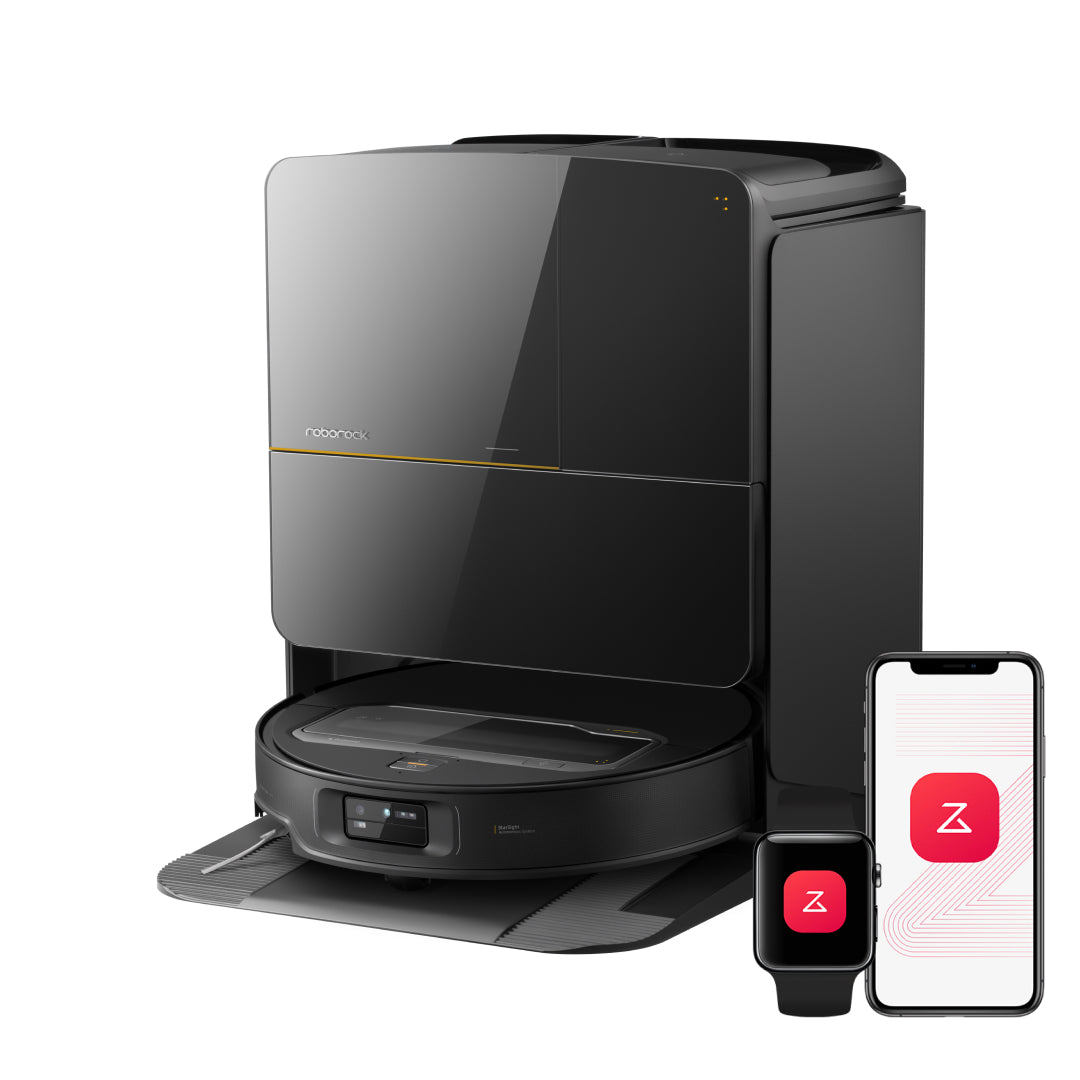
Explore this need in the finder →The Roborock Saros Z70 is the only reviewed model here whose selling point is not just a vacuum-and-mop routine: its five-axis OmniGrip arm can move a limited set of small, light floor clutter. The exact US product listing groups Black and Silver finishes under native product 7677077586038; the FCC/IC manual identifies the robot as RRE0R50 and its matching Multifunctional Dock 4.0 as EWFD28LRR. Those are finish variants of one reviewed functional package, not different operating versions.
The arm is a narrow helper, not a general-purpose picker
Roborock says the arm can lift and relocate socks, sandals, crumpled tissues, and towels weighing under 300 grams. The manual separately gives the gripper a 0.3-kilogram rated load and warns against exceeding it. Do not turn that into a claim that the robot will pick up every toy, pet item, cable, spill, or piece of rubbish. Its object-relocation feature needs app setup, the arm is disabled by default, and the current set of objects the software recognizes and organizes is limited. More object types may be added by updates, so an advertised future or custom class is not the same as a currently supported, predictable pickup.
Moving a sock may help in a doorway, but does not turn the robot into a general-purpose picker. The manual still tells you to remove cords and relocate fragile, valuable, unstable, or hazardous objects. Keep children and pets away while the arm moves, and verify an exact item and current software support before depending on pickup.
Vacuuming and mopping still define most of the day-to-day work
The robot is 13.78 by 13.9 by 3.14 inches, a useful nominal height for a lower sofa or cabinet route. Roborock lists 22,000 Pa maximum suction and a dual anti-tangle brush system. Those are manufacturer specifications, not independent pickup tests, and they do not establish how much hair or debris a particular rug will yield. The StarSight 2.0 system is described with 3D sensing and cameras; the feature page counts 108 recognizable obstacle types. That is a different number from the four currently named arm-relocation classes. Do not confuse sensing an object with being able to grip and move it.
The standard Multifunctional Dock 4.0 uses two rotating pads and handles dust emptying, pad washing/drying, detergent dispensing, and robot-water refill. Roborock claims up to 80°C wash/self-cleaning water, 55°C drying air, and 60 days between dust-bag emptying; these are not promises to ignore the station. You still service both tanks and the detergent cartridge, bag, mop cloths, tray, filter, and brushes. The dock measures 15.0 by 18.7 by 19.21 inches, before the manual’s working clearance.
Roborock calls the floor routine hot-water mopping but states no temperature for water delivered to the floor; its 80°C claim is dock washing. The manual says to fill the clean-water tank with cold tap water, not disinfectant, and use the detergent cartridge for solution. The warm-water floor routine remains a manufacturer claim without a numeric temperature.
Measure the route and obey the manual’s floor limits
The AdaptiLift chassis is advertised with up to 4 cm double-layer threshold crossing, and the feature page depicts several chassis and brush lifting modes. That is a qualified manufacturer maximum for a two-rise geometry, not a guarantee for a single tall step, a sharp track, or your particular doorway. Measure the rise and gap, preserve margin, and treat the claim as a possible fit clue rather than a route test. The manual explicitly says not to use the robot on high-pile carpet and warns that effectiveness can fall on dark carpet. This manual restriction controls even though the feature page illustrates an app-enabled mid-to-high-pile routine.
The dock needs a hard, level position near a grounded 120-volt outlet. The manual’s placement diagram calls for more than 1.2 m in front, 0.75 m in height, and 0.4 m in width; those are clearances, not dock exterior dimensions. Its app setup supports 2.4 GHz Wi-Fi only, and the product requires the Roborock app to function as intended. A household with 5 GHz-only Wi-Fi or no suitable station location should not treat the arm as a reason to overlook those practical requirements.
Who should compare it—and who should pass?
Consider the Z70 if you value the unusual option of moving a few light, pre-defined items, want an ultra-low robot body, and will use the app to configure the arm and the dock. It is less compelling if your floors are already picked up, you do not want camera-enabled software features, or you expect the gripper to replace everyday tidying. The cameras are off by default according to Roborock; decide whether you are comfortable enabling camera and obstacle-management functions before you plan to depend on them.
The Saros 10R is a useful comparison when a similarly low 3.14-inch body and spinning-pad dock matter more than an arm: its reviewed US configuration uses solid-state 3D ToF navigation and documents a 4 cm double-layer threshold claim, but no equivalent object-gripping function. Qrevo Edge 2 is another low-profile tank-dock alternative with retractable LiDAR and a separately documented 60°C floor-mop-water cycle; those details belong to its exact model and should not be copied onto the Z70. Use the Saros Z70, Saros 10R, and Qrevo Edge 2 comparison to decide which difference changes your routine.
Choose the Saros Z70 only if its limited, app-enabled object handling and the rest of its dock system answer a real need. Its 22,000 Pa figure, recognition count, and threshold maximum are manufacturer claims, not comparative lab results. If high-pile carpet, a numeric warm-water temperature, fixed plumbing, or guaranteed object pickup is essential, the reviewed sources do not establish that the Z70 meets it.
Key details at a glance
| Manufacturer-listed maximum suction | 22000 Pa |
|---|---|
| Robot height | 3.14 in |
| Manufacturer-reported dock dimension sequence (axes unspecified) | 15.0 × 18.7 × 19.21 in (381 × 475 × 488 mm) |
| Published dock mop-cleaning temperature claim | 80 °C |
| Maximum manufacturer-listed threshold claim | 4 cm |
| Battery capacity | 6400 mAh |
| Mop system | Dual spinning or rotating mop pads |
| Warm water supplied for the robot's mop cycle | Yes |
| Manufacturer-listed object-recognition types | 108 types |
| 2.4 GHz Wi-Fi supported | Yes |
| 5 GHz Wi-Fi supported | No |
| Manufacturer carpet-pile support claim | No |
| Dock water hookup | Removable dock water tanks |
| Fixed water supply and drain required | No |
| Dock empties dust automatically | Yes |
| Maximum manufacturer-claimed base dust capacity window | 60 days |
| Conditional two-step threshold claim | 4 cm |
Use the exact model’s instructions for operating limits, supplied equipment and version differences.
Sources for this assessment
Check the fit before choosing the dock.
Compare your furniture clearance, network, floors and the work the station still asks you to do.