
Your needs, this model
Does it fit your priorities?
Does Saros 20 Flow use a powered roller rather than spinning pads?
Yes. The exact Flow uses the SpiraFlow roller supplied through 16 pressurized outlets; the Saros 20 standard model uses rotating pads. This describes the system, not a cleaning result.
Explore this need in the finder →Can this exact US Flow package connect when 2.4GHz Wi-Fi is available?
Yes. Its FCC manual states only 2.4GHz Wi-Fi is supported; a 5GHz-only network is not a fit.
Explore this need in the finder →Does the Flow dock wash its roller at up to 100°C?
Yes. Roborock lists up to 100°C for the dock wash; this is not the temperature of water delivered to the floor.
Explore this need in the finder →Does the Flow documentation give a numeric floor-water temperature for its warm refill?
No. The feature page describes a warm refill to the onboard tank after wash, but the exact FAQ does not provide a floor-water temperature. A numeric minimum remains unmet.
Explore this need in the finder →Does the 3.46-inch Flow threshold maximum guarantee a single sill?
No. Roborock describes the maximum for double-layer thresholds and says results vary by the structure and home; the FAQ does not publish a single-sill maximum for this package.
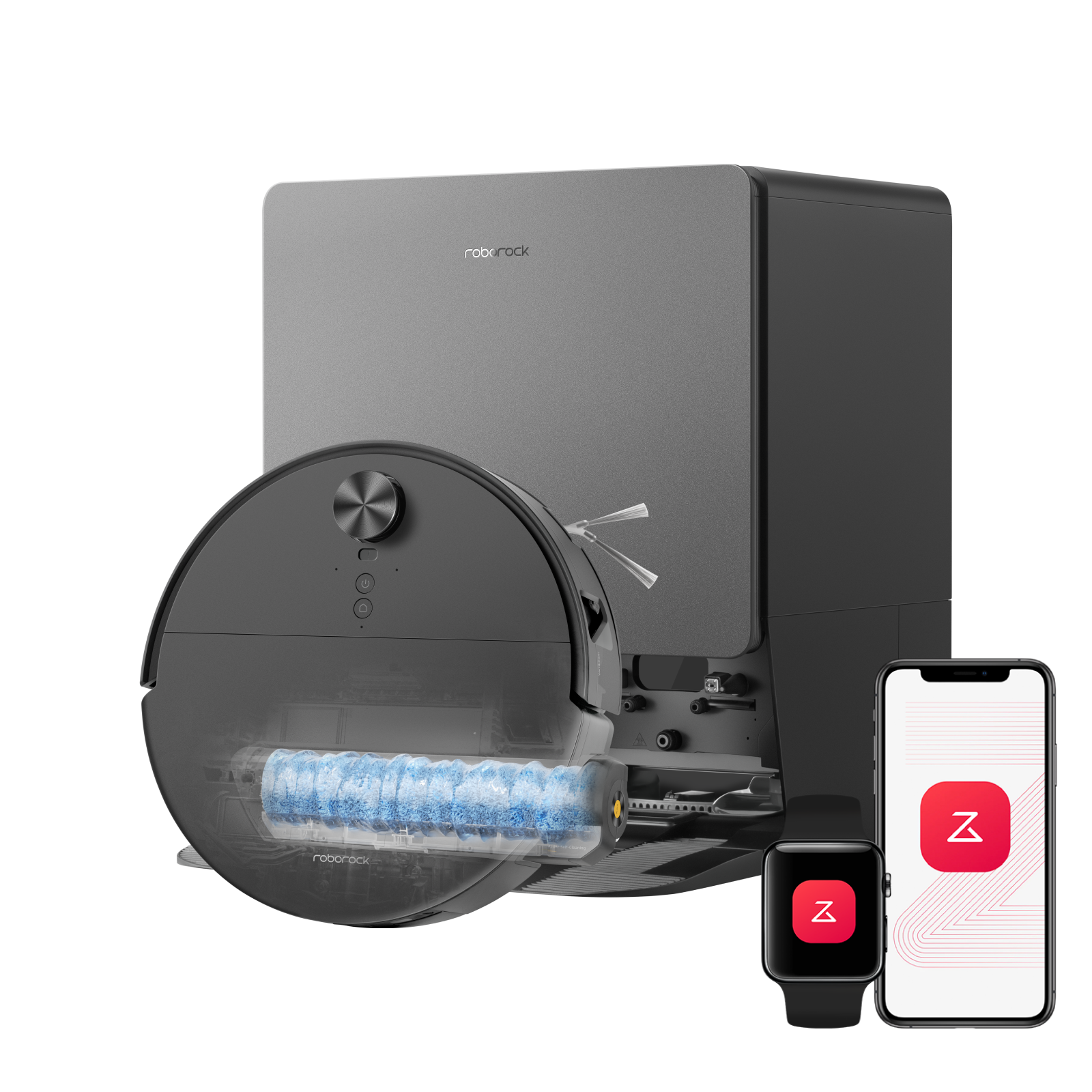
Explore this need in the finder →The Roborock Saros 20 Flow is the roller-mop member of the Saros 20 family. Its US package uses robot RRE0BES and dock EWFD71LRR, with a 3.54-inch body, a retracting laser navigation sensor, and a dock that washes and dries a powered roller. Roborock also says the dock replenishes the robot’s onboard water with warm water after a mop wash. That describes a different routine from the Saros 20’s two spinning pads; it does not make the Flow the shorter option.
Choose the roller only if you want its upkeep too
SpiraFlow 2.0 feeds clean water through 16 pressurized outlets while the roller turns at up to about 240 rpm. Roborock’s support FAQ lists up to about 15 N of downward pressure, automatic edge extension, lifting, and condition-based re-washing or re-mopping. That continuous rinse-and-scrape design is the principal reason to choose Flow over the standard Saros 20’s dual rotating pads. These are manufacturer specifications, not comparative stain tests. The FAQ does not give a numeric temperature for the water reaching the floor; keep that unknown separate from the dock’s up-to-100°C roller wash.
The robot’s own water circuit brings extra care. The manual shows an onboard dirty-water tank and a dirty-water channel that need regular checking and cleaning. It gives the roller a clean-as-needed routine and a 1–3 month replacement interval, depending on use. The station can dispense Roborock cleaning solution, empty dust, wash the roller, and dry it with up to 63°C warm air. You still replenish clean water and solution, empty the dirty-water tank, replace dust bags and consumables, and clean the cleaning tray.
Measure the clearance before admiring the low-profile claim
Roborock lists a robot height of 89.8 mm, or about 3.54 inches; the product FAQ repeats that rounded height. A lifting and retracting LDS helps it enter spaces that suit its profile, but the listed body remains taller than the standard Saros 20’s 3.14 inches. Measure the lowest part of the route, including soft fabric and floor transitions. A narrow opening that fits the Saros 20 can still reject Flow.
AdaptiLift Traverse 3.0 is advertised for double-layer transitions up to 3.46 inches, while Roborock cautions that actual results vary with the threshold structure and home. This number describes a tested maximum for a layered obstacle, not a promise for every door track or a conventional single rise. Do not use it as a substitute for measuring the two rises and the gap between them.
Vacuum claims and carpet limits need context
Roborock lists up to 36,000 Pa suction and a DuoDivide main brush with a dual anti-tangle system. The robot is also advertised with app control, object avoidance, camera features, and a pet-friendly mode. These claims are not independent pickup, hair-wrap, or avoidance measurements. The manual still tells owners to clear cords and loose objects and supervise the first complete route.
The exact US manual says not to use Flow on high-pile carpets and warns that dark carpets may reduce effectiveness. Its roller retracts and a cover slides out when it reaches carpet, but that protective behavior is not authorization for high-pile use. The broad product description mentions recognizing certain messes; the manual also warns against operation on a floor with liquid or sticky material. Treat this as a maintained floor-washing robot, not a wet-spill extractor.
Separate warm refill, dock wash, and floor water
The feature page says the dock sends warm water to the onboard tank after each mop wash. Its FAQ states up to 100°C for dock washing and up to 63°C for drying air. The clean tank itself is filled with cold tap water according to the manual; the dock’s later warming stage is distinct. Roborock does not publish a numeric temperature for water applied to the floor in the materials reviewed here, so an exact floor-temperature minimum should not match.
The included dock is a removable-tank station, not a fixed supply-and-drain installation. The product page gives 381 × 454 × 451 mm for the dock and 352 × 353 × 89.8 mm for the robot; it does not label the dimension order on that line, so measure the installation spot against the actual station. The manual calls for a hard, level surface and clearance around the dock, while its safety section requires a grounded 120 V outlet. App setup supports 2.4 GHz Wi-Fi only, not a 5 GHz-only network.
What the runtime claim really says
The 6,400 mAh battery and 36,000 Pa maximum suction are manufacturer specifications. Roborock’s support FAQ estimates up to 301 minutes and 348 square meters in one run only in vacuum-only mode, without the mop, at the lowest suction setting; the same answer says actual coverage varies by mode, floor, environment, and use. Do not translate that best-case setting into a whole-home mopping guarantee.
Who should compare it with the Saros 20?
Flow is the more specific choice for a buyer who values a refreshed powered roller and automated roller washing, accepts extra dirty-water-channel care, has enough clearance for a 3.54-inch robot, and can use the app on a 2.4 GHz network. Compare the standard Saros 20 if a lower 3.14-inch body and two spinning pads fit better; it uses a different obstacle-sensing system and has its own manual carpet restriction. Neither is a maintenance-free station, a guaranteed threshold climber, or evidence of measured cleaning results. Read the exact model manual and test the route before building an automated schedule.
Key details at a glance
| Manufacturer-listed maximum suction | 36000 Pa |
|---|---|
| Robot height | 3.54 in |
| Published dock mop-cleaning temperature claim | 100 °C |
| Maximum manufacturer-listed threshold claim | 8.8 cm |
| Battery capacity | 6400 mAh |
| Mop system | Real-time refreshed roller mop |
| Warm water supplied for the robot's mop cycle | Yes |
| LiDAR retracts under low furniture | Yes |
| 2.4 GHz Wi-Fi supported | Yes |
| 5 GHz Wi-Fi supported | No |
| Manufacturer carpet-pile support claim | No |
| Dock water hookup | Removable dock water tanks |
| Fixed water supply and drain required | No |
| Dock empties dust automatically | Yes |
| Conditional two-step threshold claim | 8.8 cm |
Use the exact model’s instructions for operating limits, supplied equipment and version differences.
Sources for this assessment
Check the fit before choosing the dock.
Compare your furniture clearance, network, floors and the work the station still asks you to do.