
Your needs, this model
Does it fit your priorities?
Will the Qrevo S Pro fit through a measured four-inch furniture opening?
Roborock lists a 3.8-inch robot. Four inches leaves little margin for rugs, trim and uneven floors, so measure the tightest point along the route.
Explore this need in the finder →Does Roborock publish a 75°C-or-higher dock pad-cleaning claim for the Qrevo S Pro?
Roborock lists up to 75°C for high-temperature dock self-cleaning. Its footnote says the figure is measured at internal heater output, not at the mop; actual wash-water or pad temperature is not confirmed.
Explore this need in the finder →Can the Qrevo S Pro be selected if high-pile carpet is an essential part of the route?
No. Its exact FCC manual says not to use the robot on high-pile carpet and warns that dark-carpet effectiveness may be reduced.
Explore this need in the finder →Can the Qrevo S Pro connect where a 2.4GHz network is available?
Yes. Its exact FCC manual supports 2.4GHz Wi-Fi only; a 5GHz-only network does not meet the documented setup requirement.
Explore this need in the finder →Can its dock run from removable water tanks without fixed plumbing?
Yes. The reviewed EWFD24LRR package uses clean- and dirty-water tanks; the owner fills and empties them instead of installing a fixed supply and drain.
Explore this need in the finder →Does it mop floors with heated water supplied to the robot?
That is not documented. The manual instructs the owner to use cold tap water in the clean tank; the 75°C value concerns dock pad washing.
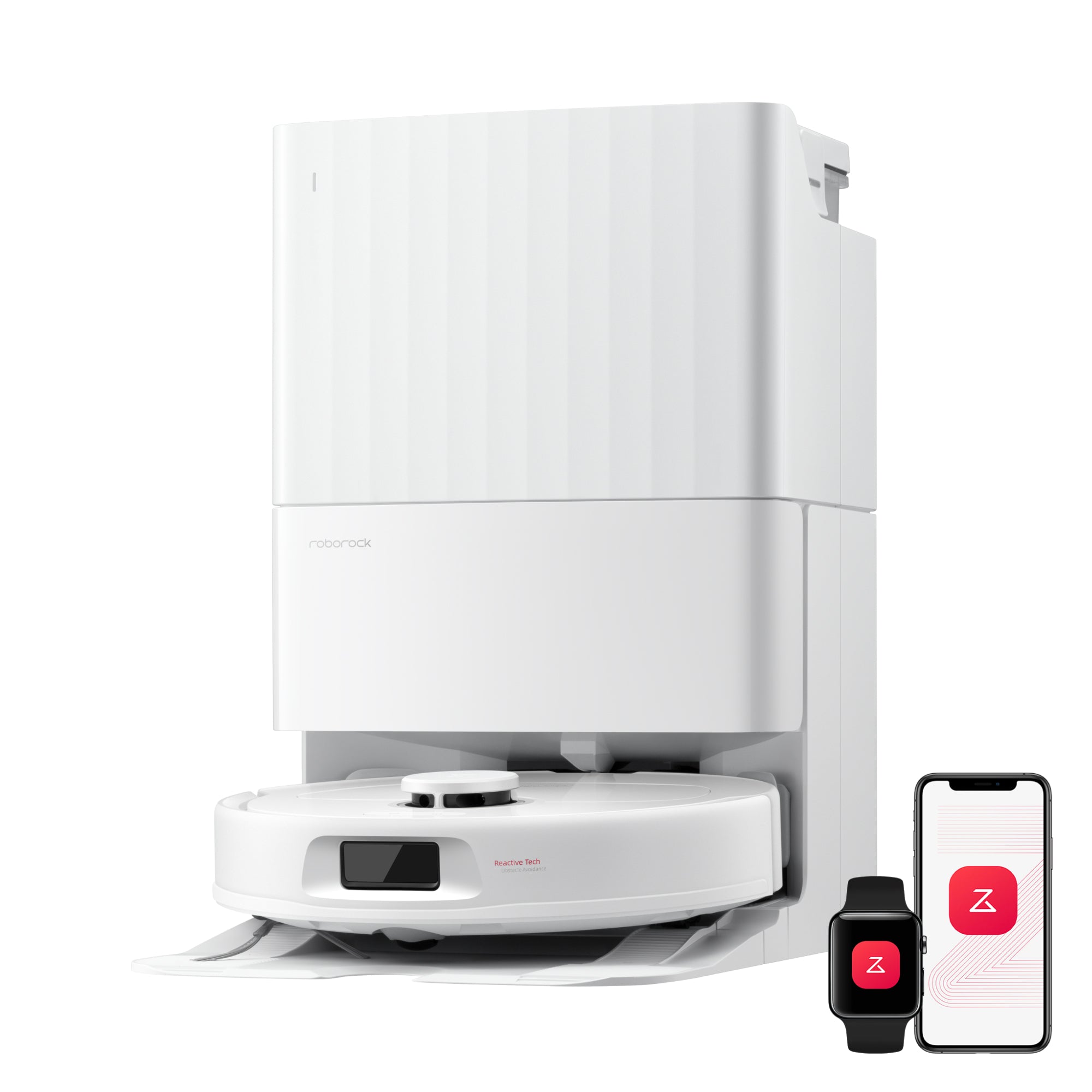
Explore this need in the finder →The Roborock Qrevo S Pro pairs a 3.8-inch robot with two rotating mop pads and a removable-tank dock that empties dust, washes and dries pads, and refills the onboard tank. Roborock lists 18,500 Pa suction and 45°C warm-air drying; its up-to-75°C dock-cleaning figure is an internal heater-output reading, not the mop temperature. The owner still services tanks, the dust bag, reusable cloths and the station tray.
It is not a fit for high-pile carpet: the exact FCC manual says not to use the robot on it. Compare the Qrevo S5V and QV 35A for different dock routines and published specifications.
Measure the whole route around a 3.8-inch robot
Roborock lists the robot body at 13.8 by 13.9 by 3.8 inches. A nominal four-inch gap leaves just two tenths of an inch before uneven flooring, a rug edge or fabric sag. Measure the narrowest point along the full route, including doorways, table aprons and furniture skirts. With its raised LiDAR sensor, this is not the very-low-profile choice in Roborock’s range.
The dock needs a different amount of space. Its published dimensions are 13.4 by 19.2 by 20.4 inches. The manual asks for a hard, flat position against a wall with at least 0.4 meters of side clearance, 1.2 meters in front and 0.9 meters of headroom. A carpet or mat beneath the station can tilt it; a tight cabinet may block the route back or your access to the tanks. Leave enough room to lift off the clean- and dirty-water reservoirs, not just to park the robot.
Its mop automation helps, but does not remove routine care
The two spinning pads lift when the robot detects carpet, and its dock can wash and warm-air dry them, empty the dustbin and refill the robot’s water tank. This is a removable-tank system: refill clean water, pour out dirty water, replace the dust bag, and clean the dock base and tray as needed. The high-temperature cleaning claim is separate from water put on the floor. Roborock’s footnote says 75°C is an internal heater-output reading, not a mop-temperature measurement; the manual calls for cold water in the clean tank and no disinfectant.
Roborock lists an all-rubber main brush, an anti-tangle side brush, structured-light obstacle avoidance and PreciSense LiDAR navigation. These specifications are not independent pickup measurements. Spinning pads cannot replace direct stain cleaning or reach stairs and spaces the robot cannot enter.
For the first mop cycle, the manual recommends vacuuming the floor at least three times to reduce dirt buildup on the pads. It says to clean the main brush every two weeks and replace it every six to twelve months; the washable filter has the same clean-and-replace schedule. The side brush should be cleaned monthly and replaced every three to six months. Clean the mop cloths when required, air-dry them, and replace them every one to three months. Actual intervals depend on use, but the station does not make these checks disappear.
Carpet, Wi-Fi and floor conditions are real limits
The manual explicitly says not to use the Qrevo S Pro on high-pile carpet and warns that performance may be reduced on dark carpets. Automatic mop lifting is useful on suitable carpets, but it does not override the high-pile restriction. If thick carpet is a required part of the route, do not treat a spinning-pad lift as proof of support. Likewise, the manual says to keep the floor free of liquid and sticky material; do not send the robot to deal with a wet spill.
The exact manual supports 2.4GHz Wi-Fi only, so a 5GHz-only network does not satisfy the documented app setup. Roborock’s app is part of the routine for maps and schedules, and the station needs a reasonably open location. Consider another model if your available space is unusually tight.
How it differs from Qrevo S5V and QV 35A
Roborock lists 18,500 Pa for the S Pro and 8,000 Pa for the QV 35A; the S5V lists 12,000 Pa and 30 water-flow levels. These are maker specifications, not comparative cleaning results. The S5V’s reviewed U.S. sources give no numeric dock-cleaning claim. The QV 35A lists cold-air drying; the S Pro lists warm-air drying and high-temperature dock cleaning. Actual S Pro wash-water or mop temperature is not stated.
Choose the S Pro if its dock automation, 3.8-inch listed height and tank routine suit your home. If a specific water or pad temperature is essential, its heater-output claim is not enough to confirm it. The QV 35A may be adequate if heated dock cleaning is not important; the S5V offers more water-flow settings. None of these suction figures establishes measured cleaning in your home.
Who should skip it?
Skip it if you need high-pile carpet coverage, 5GHz-only Wi-Fi, fixed water connections or a robot shorter than 3.8 inches. It also needs an open station position and periodic tank, bag, cloth and tray care. For suitable hard-floor and ordinary carpet routes, its dock automates more chores than a basic charging station without making the appliance maintenance-free.
Key details at a glance
| Manufacturer-listed maximum suction | 18500 Pa |
|---|---|
| Robot height | 3.8 in |
| Manufacturer-reported dock dimension sequence (axes unspecified) | 13.4 × 19.2 × 20.4 |
| Published dock mop-cleaning temperature claim | 75 °C |
| Battery capacity | 5200 mAh |
| Mop system | Dual spinning or rotating mop pads |
| Warm water supplied for the robot's mop cycle | No |
| LiDAR retracts under low furniture | No |
| 2.4 GHz Wi-Fi supported | Yes |
| 5 GHz Wi-Fi supported | No |
| Manufacturer carpet-pile support claim | No |
| Dock water hookup | Removable dock water tanks |
| Fixed water supply and drain required | No |
| Dock empties dust automatically | Yes |
| Maximum manufacturer-claimed base dust capacity window | 65 days |
Use the exact model’s instructions for operating limits, supplied equipment and version differences.
Sources for this assessment
- Roborock US Qrevo S Pro product page, features, comparison, contents and specifications
- Roborock native U.S. Qrevo S Pro product record and Black/White finish variants
- Roborock Qrevo S Pro FCC English user manual
- Roborock U.S. support page naming Qrevo S Pro FCC and CE manuals
- Roborock Qrevo S Pro manufacturer feature page with temperature, dock and 65-day claims
- CPSC SaferProducts exact-name recall query: Roborock Qrevo S Pro
- CPSC SaferProducts exact-code recall query: RRE0PEE
- CPSC SaferProducts exact-dock-code recall query: EWFD24LRR
Check the fit before choosing the dock.
Compare your furniture clearance, network, floors and the work the station still asks you to do.