
Your needs, this model
Does it fit your priorities?
Does the Qrevo Edge 3 Pro have a published maximum suction specification of at least 30,000 Pa?
Roborock lists up to 36,000 Pa. That is a maker maximum specification, not a comparative pickup test.
Explore this need in the finder →Does its dock wash the mop cloths at up to 100°C, rather than merely drying them with warm air?
The FAQ claims dock washing up to 100°C and separately lists 55°C drying air. Neither number describes the robot's water temperature on the floor.
Explore this need in the finder →Will its approximately 3.14-inch body fit a measured 3.5-inch opening?
The listed robot height is about 3.14 inches and the LiDAR retracts, but a 3.5-inch opening leaves little tolerance for fabric, rug edges or uneven flooring.
Explore this need in the finder →Does Roborock publish a double-layer threshold crossing claim for the Edge 3 Pro?
Yes, up to about 3.46 inches overall only under its stated two-rise/gap conditions; this is not a guarantee for a single tall ledge.
Explore this need in the finder →Is warm-water mopping on the floor different from the 100°C station wash?
Yes. Roborock calls the mop cycle warm-water mopping, but its inspected FAQ does not give a numeric floor-water temperature. The 100°C figure is for the dock washing pads.
Explore this need in the finder →Does the standard US package require a fixed water line or drain?
No. The EWFD74LRR manual describes clean- and dirty-water tanks; you fill and empty them instead of installing the separate fixed-plumbing system.
Explore this need in the finder →Can its mop pads and mounts automatically lift or detach for some carpet routines?
The manual and FAQ describe automatic lifting and app-enabled mount detach/reinstall under specific conditions; do not assume every carpet or run triggers it.
Explore this need in the finder →Does Roborock explicitly describe carpet cleaning for the exact Edge 3 Pro?
Yes. Its US feature page claims dynamic carpet cleaning up to 1.18 inches and says the function must be manually enabled in the app. This bounded claim does not cover thicker pile or prove tested results.
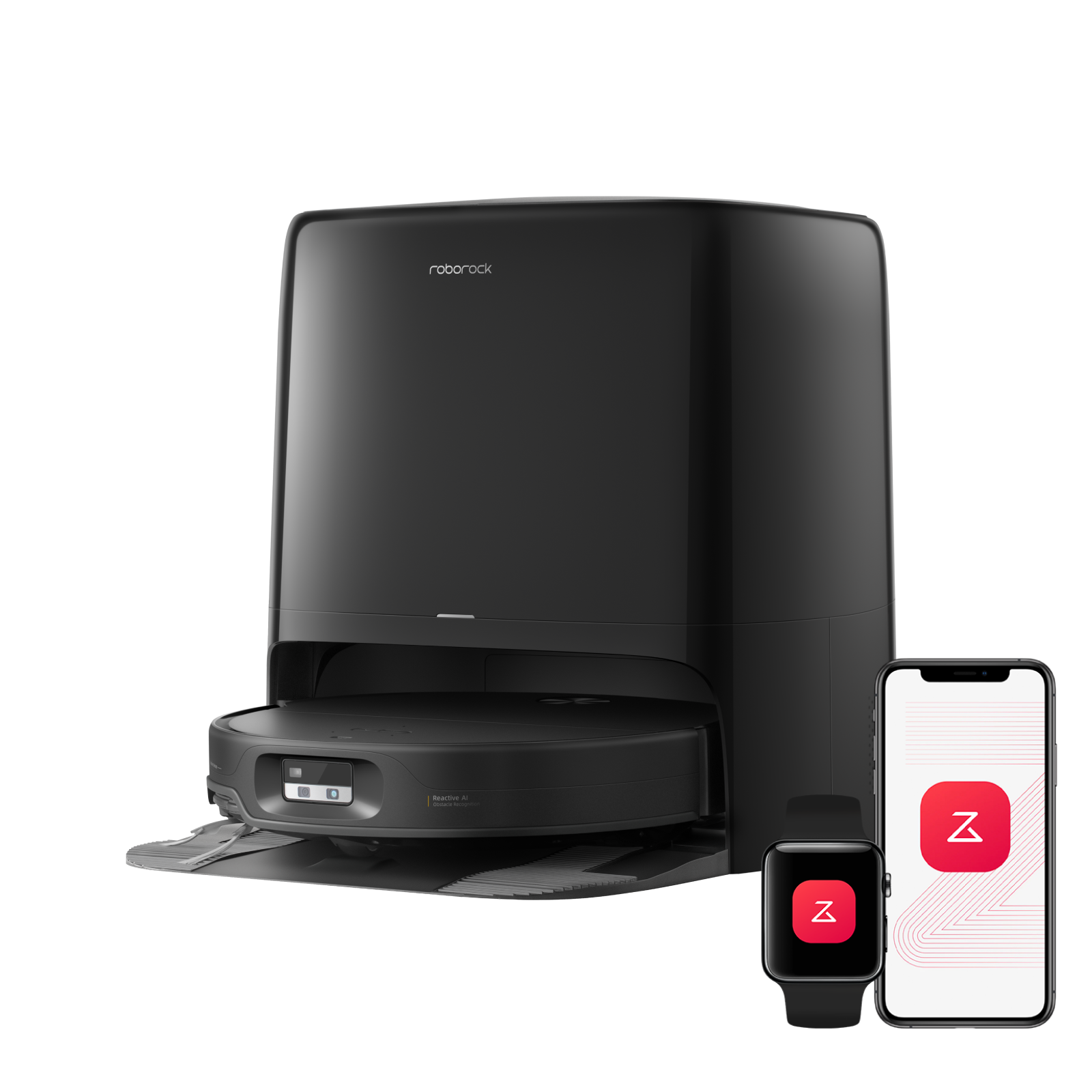
Explore this need in the finder →The Roborock Qrevo Edge 3 Pro combines a low, retractable-LiDAR robot with a twin-pad mop and a removable-tank service dock. Its US FCC manual identifies the robot as RRE0VIF and the Empty Wash Fill Dock as EWFD74LRR. Roborock lists two color variants—black and white—under one US product record. The finish changes the shell color, not the documented operating plan. When checked on October 23, 2026, the exact US product page said the model had not launched yet; this is a specification reference, not a currently available buying recommendation. Recheck Roborock’s launch status before considering it.
Separate the mop cycle from the dock wash
On the floor, the Edge 3 Pro uses dual spinning pads. Roborock describes warm-water mopping, pad rotation at approximately 200 rpm and downward pressure of 8–14 N. The FAQ does not give a numeric temperature for water used by the robot during the floor-mopping cycle, so a buyer who needs an explicit minimum such as 60°C should treat that requirement as unconfirmed. Do not borrow the dock's hotter number: Roborock says the station washes pads at up to 100°C and dries them with 55°C air. Those are manufacturer specifications for separate processes, not independent cleaning or hygiene tests.
The dock also empties dust, refills the robot's reservoir, cleans its own wash area and dispenses floor-cleaning solution from a cartridge. Its claimed 4-liter clean-water tank, 3-liter dirty-water tank, 2.7-liter dust bag and roughly 480-milliliter solution cartridge indicate what still needs handling. It is not a plumbed model: you refill the clean tank, remove and empty the dirty one, and eventually replace the bag or solution. The station needs dedicated space, a grounded outlet and enough overhead clearance to lift its covers and tanks.
Very low body, but route claims need context
Roborock's FAQ lists the robot at about 3.14 inches tall and describes passability under openings around 3.13 inches. RetractSense LiDAR lowers under some furniture, but the advertised number is not a promise that every route beneath a bed is safe. Check hanging fabric, floor transitions, rug edges and the clearance at the narrowest point. Leave some margin instead of treating a nominal gap barely taller than the shell as guaranteed access.
Threshold language needs the same care. Roborock claims up to 1.77 inches for a single-level transition and up to 3.46 inches for a double-layer crossing. The larger figure is qualified: the manufacturer describes a first rise no taller than 1.77 inches, a gap greater than 4.72 and no more than 5.51 inches, and a second rise no taller than 1.69 inches. That is a specific two-step geometry, not a general ability to climb one 3.46-inch ledge. The claims also remain maximum manufacturer figures rather than tested results on your flooring.
Large specifications are not home measurements
Roborock lists maximum suction of 36,000 Pa and a DuoDivide anti-tangle main brush, plus a side brush and extendable mop intended to reach along edges. It also describes Reactive AI obstacle recognition and more than 300 object types. Treat these as design and marketing specifications; neither suction pressure nor the recognition count predicts how well it will collect a particular carpet pile or avoid every household object.
The exact product FAQ advertises up to about 256 minutes and 286 square meters in a lowest-suction, vacuum-only test, and roughly 64 dB(A) in standard vacuum-and-mop mode or 56 dB(A) in mop-only mode. Those are stated maker conditions, not independent room-scale measurements. Carpet, higher suction, furniture, the mop module and station cycles all change a real routine. The same caution applies to its claimed 6,400 mAh battery and roughly four-hour charging time.
Read the manual before mapping
The FCC manual says the robot works on 2.4 GHz Wi-Fi only, so it is not a fit for a home offering only a 5 GHz network. It requires a grounded outlet and asks for about 2.7 feet above the dock, 1.38 feet on each side and 3.94 feet in front, on a hard, level surface. Before the first mop run, Roborock says to vacuum the floors at least three times. Use cold tap water when filling the clean-water tank, avoid disinfectants, and use only Roborock-recommended cleaner in the cartridge. That cold-fill instruction is not a contradiction of warm-water mopping: the dock has a separate process for the robot's mop cycle.
The manual also says to keep the robot off floors with liquid or sticky substances, clear loose cords and hazards, and follow the app instructions for setup. Roborock’s exact US feature page makes a bounded carpet claim: dynamic cleaning for carpets up to 1.18 inches, with the feature manually enabled in the app. That is a manufacturer specification, not an independent pile-depth test and not support for thicker carpet. The app can also detach the mop in its Vacuum Carpet First mode under specific conditions; lifting or detaching the pads does not erase the 1.18-inch limit.
Who should consider it?
This model is worth considering if you want a particularly low retractable-LiDAR body, rotating pads and a tank-based dock that automates dust emptying, pad washing, drying and refill. It is less compelling if your hard requirement is a published floor-mop temperature, a fixed water hookup, 5 GHz-only Wi-Fi or confirmed high-pile use. The dock reduces chores but cannot remove them, and its 100°C wash should not be mistaken for a 100°C floor-mop cycle.
Compared with the Qrevo Edge 2, Edge 3 Pro adds higher listed suction and a 100°C dock-wash specification, plus an explicit qualified threshold claim; Edge 2 has a published 60°C robot-mop water figure, which Edge 3 Pro's reviewed FAQ does not. For a refreshed roller rather than twin pads, the taller Qrevo Curv 2 Flow is a different design to investigate. Read the exact Roborock US product page, its US support/manual listing the model FAQ and feature details alongside your measured route and station location before buying.
Key details at a glance
| Manufacturer-listed maximum suction | 36000 Pa |
|---|---|
| Robot height | 3.14 in |
| Manufacturer-reported dock dimension sequence (axes unspecified) | 15.83 × 19.45 × 17.72 in, per exact US feature-page key specs. |
| Published dock mop-cleaning temperature claim | 100 °C |
| Maximum manufacturer-listed threshold claim | 4.5 cm |
| Battery capacity | 6400 mAh |
| Mop system | Dual spinning or rotating mop pads |
| Warm water supplied for the robot's mop cycle | Yes |
| LiDAR retracts under low furniture | Yes |
| Manufacturer-listed object-recognition types | 300 types |
| 2.4 GHz Wi-Fi supported | Yes |
| 5 GHz Wi-Fi supported | No |
| Manufacturer carpet-pile support claim | Yes |
| Maximum manufacturer-listed carpet pile | 1.18 in |
| Dock water hookup | Removable dock water tanks |
| Fixed water supply and drain required | No |
| Dock empties dust automatically | Yes |
Use the exact model’s instructions for operating limits, supplied equipment and version differences.
Sources for this assessment
- Roborock US Qrevo Edge 3 Pro product page
- Roborock US Qrevo Edge 3 Pro feature/specification page
- Roborock US native Qrevo Edge 3 Pro product record
- Roborock US Qrevo Edge 3 Pro support and manual listing
- Roborock Qrevo Edge 3 Pro FCC/IC English user manual
- Roborock US Qrevo Edge 3 Pro FAQ
- Roborock US native robot-vacuum collection page 1
Check the fit before choosing the dock.
Compare your furniture clearance, network, floors and the work the station still asks you to do.