
Your needs, this model
Does it fit your priorities?
Does this configuration use a powered roller that is refreshed with clean water as it mops, rather than two spinning pads?
Yes. Roborock describes the Qrevo Curv 2 Flow as a real-time self-cleaning roller system. This identifies the mop mechanism; it is not an independent test that the roller cleans better in every home.
Explore this need in the finder →Can the robot join a 2.4GHz Wi-Fi network for app setup?
Yes. The exact US FCC manual supports 2.4GHz Wi-Fi and says 5GHz is not supported. The Roborock app is required for intended operation.
Explore this need in the finder →Is Roborock explicit that this robot is suitable for high-pile carpet?
No. The US manual says not to use this model on high-pile carpet and warns that dark carpet may reduce effectiveness.
Explore this need in the finder →Does Roborock publish a threshold-crossing minimum for this exact robot-and-dock configuration?
No such minimum appears in the product page or US manual reviewed here. An essential threshold claim cannot be supplied by a Curv sibling.
Explore this need in the finder →Can the included dock work with removable water tanks instead of fixed plumbing?
Yes. The US manual shows removable clean- and dirty-water tanks and a robot refill port; the station is not the separate fixed-supply-and-drain package.
Explore this need in the finder →Will the 119mm-tall robot pass a 4.25-inch furniture opening on the documented height alone?
No. The published robot height converts to about 4.69 inches, above that opening before allowing clearance for a real route.
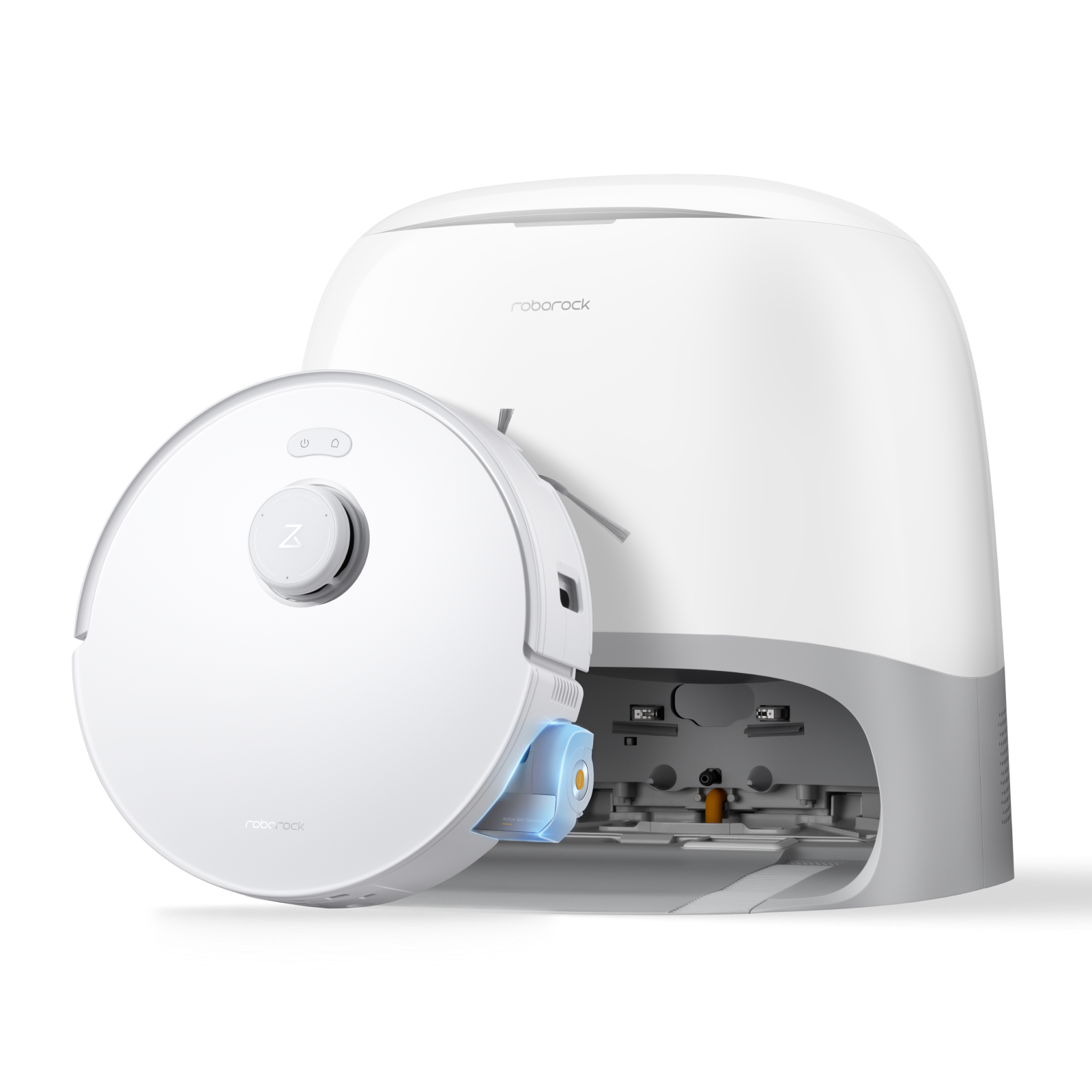
Explore this need in the finder →The Roborock Qrevo Curv 2 Flow is a vacuum-and-mop robot built around a different kind of mop than the Qrevo Curv and CurvX: a continuously rinsed roller rather than two rotating pads. Its US package combines robot RRE0BEL with Empty Wash Fill Dock EWFD53LRR (native SKU RR-QrevoCurv2Flow0-M1). It suits hard-floor homes that can maintain a water-and-wastewater station. It is a poor fit if high-pile carpet is essential, the robot must pass under low furniture, or you want a robot to handle wet spills without resolving a caution in the manual.
A roller changes both the mop and the upkeep
Roborock describes SpiraFlow as a real-time self-cleaning roller. The 270mm roller receives clean water through several feed points; a scraper removes excess moisture and directs dirty water toward a separate onboard tank. The maker lists up to 220 revolutions per minute at its highest custom water-flow setting and up to 15N of downward pressure. These are manufacturer claims, not independent cleaning results. The roller reaches close to edges and is designed to extend; it is not the same arrangement as the Curv’s pair of spinning pads.
The robot returns to its dock to wash the roller, refill its water supply and empty dust. Roborock lists water up to 75°C at the dock heater output and drying air up to 55°C at the outlet. Those numbers describe station processes, not the temperature of water the robot puts on the floor. The removable-tank dock needs a clean-water refill and a dirty-water dump; dust auto-emptying and mop washing do not make the station maintenance-free. You will still empty the wastewater, change the dust bag and clean the tray, roller channel and onboard dirty-water tank.
Wet-mess marketing has an important manual caveat
The product page promotes mop-only handling of wet stains and describes the roller as suitable for spills. The US manual, however, cautions against using the product if there is any liquid or sticky substance on the floor. The manufacturer’s materials do not explain how that general safety instruction relates to its wet-mess examples. Do not interpret the marketing demonstrations as permission to drive through a puddle, sticky spill or standing liquid; if that is a deal-breaker, ask Roborock to clarify the permitted use for this exact US configuration. This review treats safe wet-spill capability as unresolved rather than promising it.
That caveat does not erase the basic function: the robot has a powered roller mop and water system for routine damp mopping. It does mean this model should not be bought as a substitute for a wet/dry floor washer or a spill-cleanup appliance. Roborock also instructs owners to use only its recommended cleaning solution, not disinfectant, and to use cold water when filling the tanks. Follow the full manual for chemicals and floor conditions.
Measure the robot and carpet before choosing the mop
The official US product page lists a 353 by 353 by 119mm robot, about 13.9 inches square and 4.69 inches tall. Its 450mm-cube dock is about 17.7 inches on each side. The manual asks for a hard, flat station location with roughly 0.46m of width, 1.2m of depth and 0.9m of height available. A 4.7-inch robot will not solve a low-sofa route; measure the lowest obstruction and allow extra margin for rugs, fabric and uneven floors. Roborock publishes no threshold-crossing minimum for this exact configuration, so do not borrow one from another Curv-family model.
There is a useful carpet shield: the roller lifts up to 15mm and a cover deploys as the robot approaches carpet. But Roborock’s US manual explicitly says not to use the machine on high-pile carpets and warns that dark carpet may reduce effectiveness. The 15mm lift is not a universal clearance guarantee for rugs, fringes or transitions. If a deep-pile rug must be cleaned, or you cannot keep the robot away from it, the Flow is not a supported match. App settings can mark carpets as no-go areas, but the owner must configure and check those boundaries.
The station is powerful, not small or hands-off
The 20,000Pa suction figure is Roborock’s maximum tested value, not a pickup score on your flooring. The robot combines LiDAR mapping, a camera-based obstacle-recognition system, a DuoDivide main brush and lifting side brushes. Roborock claims more than 200 recognized object types, not perfect avoidance of cables or pet obstacles. Cameras are switched off by default on the product page and require permission to activate, so review privacy settings if you use video or pet features. The app is required for intended operation, and the manual supports 2.4GHz Wi-Fi only; a 5GHz-only network is incompatible.
The robot’s cleaning system adds hands-on service tasks. The roller must be removed and thoroughly air-dried after cleaning; clean its onboard wastewater tank and channel as needed and the main brushes every two weeks. It calls for regular washable-filter cleaning and dust-bag replacement. Before the first mopping run, it advises vacuuming at least three times to reduce dirt building up on the mop. Those jobs are sensible for a wet mechanism, but they are more involved than a standard vacuum-only dock.
Who should choose the Qrevo Curv 2 Flow?
Choose it if a roller mop is a genuine priority, most of your route is hard flooring, you have space for the station and removable tanks, and your carpet is not high pile. Its roller, edge reach, auto-washing and dust emptying give it a distinct operating routine, not a blanket advantage over every spinning-pad robot. For lower furniture, compare the shorter CurvX; it keeps spinning pads rather than this roller, so that is a trade rather than a direct upgrade. The original Qrevo Curv is another spinning-pad alternative with a shorter listed body than the Flow. If you want no wet maintenance, choose a vacuum-only model instead. And if wet-spill cleanup or high-pile coverage is essential, wait for a direct answer from the manufacturer or choose a product with unambiguous instructions.
Key details at a glance
| Manufacturer-listed maximum suction | 20000 Pa |
|---|---|
| Robot height | 4.69 in |
| Manufacturer-reported dock dimension sequence (axes unspecified) | 17.7 × 17.7 × 17.7 in |
| Published dock mop-cleaning temperature claim | 75 °C |
| Battery capacity | 5200 mAh |
| Mop system | Real-time refreshed roller mop |
| Warm water supplied for the robot's mop cycle | No |
| 2.4 GHz Wi-Fi supported | Yes |
| 5 GHz Wi-Fi supported | No |
| Manufacturer carpet-pile support claim | No |
| Dock water hookup | Removable dock water tanks |
| Fixed water supply and drain required | No |
| Dock empties dust automatically | Yes |
| Maximum manufacturer-claimed base dust capacity window | 65 days |
Use the exact model’s instructions for operating limits, supplied equipment and version differences.
Sources for this assessment
- Roborock US Qrevo Curv 2 Flow product page and specifications
- Roborock US native product record for Qrevo Curv 2 Flow
- Roborock US support page listing the Curv 2 Flow FCC/IC English user manual
- Roborock Qrevo Curv 2 Flow FCC/IC English user manual
- CPSC exact-name recall database search for Qrevo Curv 2 Flow
- CPSC recall database search for robot model RRE0BEL
Check the fit before choosing the dock.
Compare your furniture clearance, network, floors and the work the station still asks you to do.