
Your needs, this model
Does it fit your priorities?
Do you specifically want the Flow’s self-rinsing track mop rather than spinning pads?
The U.S. Flow page and YJCC026 manuals describe a FlowWash rolling track mop; it is not a dual-spinning-pad design.
Explore this need in the finder →Can the Flow wash and dry its roller at the dock without a fixed plumbing connection?
The YJCB026BL basic station uses removable clean- and dirty-water tanks and performs automatic mop wash/dry. The separate YJCB026SL plan requires water supply and drain connections.
Explore this need in the finder →Does the Flow meet a 23,000 Pa minimum listed-suction requirement?
No. Narwal’s exact Flow page lists 22,000 Pa maximum suction; that maker rating is not a pickup test.
Explore this need in the finder →Is the manufacturer-published dock mop-wash temperature confirmed at 60°C or higher?
No exact numeric dock-wash temperature is established in the inspected Flow manual/page. Warm-water roller cleaning is described, but an essential 60°C dock-wash minimum remains unknown.
Explore this need in the finder →Can you rely on one exact battery-capacity figure for an essential minimum?
No. The manual lists 5,900 mAh and the page specification table 5,000 mAh; leave the hard-filter capacity unknown.
Explore this need in the finder →Does the exact Flow support 5-GHz-only Wi-Fi?
Yes. The YJCC026 basic-dock manual lists 2.4- and 5-GHz Wi-Fi. The 2.4-GHz band is also supported.
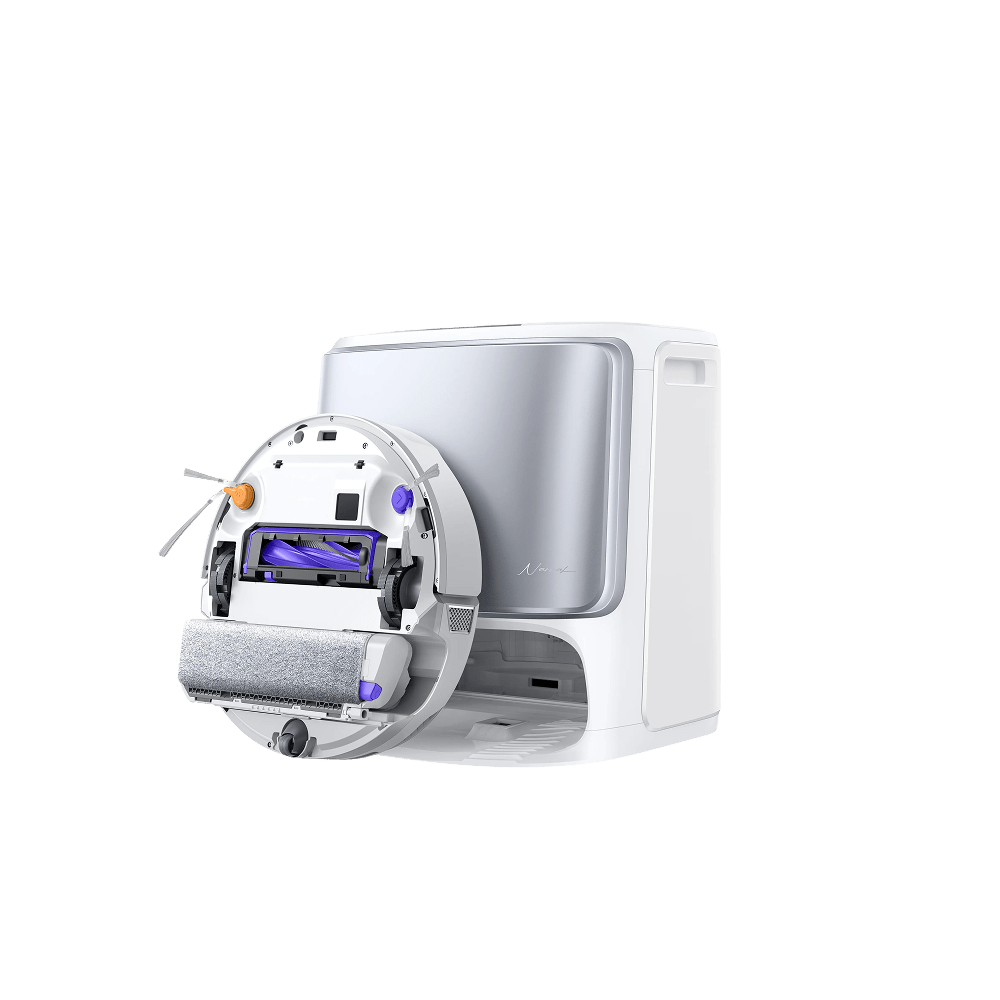
Explore this need in the finder →The Narwal Flow is a robot vacuum-mop whose distinctive feature is a rolling track mop that the maker says rinses itself as it moves. This assessment covers the exact U.S. product family built around robot YJCC026, with either its removable-tank basic dock or a separate refill-and-drain dock. Those stations are not interchangeable for a household-plumbing questionnaire. Narwal also lists a basic-dock package with an Advanced Kit; that kit adds consumables, not another robot or a new cleaning mode.
Start with the model and the dock
Narwal’s U.S. product record identifies item 10199957766325. Its base-dock variant is 51473057251509, SKU CP-ZD-A00156-00-00_DTC_N_US_QI_250806. The linked basic-dock manual identifies the robot as YJCC026 and the multifunction station as YJCB026BL. The separate “Auto Refill & Drainage System” variant is 51473057284277, SKU CP-ZD-A00162-00-00_DTC_N_US_QI_250806; its page-linked manual retains robot code YJCC026 but names station YJCB026SL. It is described as a DIY installation. The third variant, 52609792966837, adds the separately listed Advanced Kit to the basic-dock package. The kit’s own U.S. page itemizes two track mops, two disposable filters, two two-piece side-brush sets, one roller brush, three station dust bags, one disposable bag container, two HEPA filters and two floor detergents. These supplies do not change the robot’s capabilities.
The roller is useful only if its maintenance suits you
Flow’s main difference from a conventional flat cloth or spinning pads is its moving track. Narwal describes fresh water reaching and rinsing that roller during the cleaning pass, with 7–12 N of listed downward pressure and an extending edge mop. The U.S. page claims 113°F water for this FlowWash action and a 12 mm mop lift; these are maker specifications, not independent measurements of stain removal, edge coverage or carpet protection. The manual confirms a track-mopping module and four selectable routines: vacuum only, mop only, vacuum and mop together, and vacuum followed by mopping.
Both documented docks empty debris, wash the mop and dry it after cleaning. That reduces pad handling but does not eliminate chores. With the basic dock, the manual shows removable clean- and dirty-water tanks, a dust bag, a cleaning filter and a detergent holder; the owner fills and empties the tanks and still has to clean the station and replenish consumables. The manual asks for at least 0.45 m of open floor in front of the dock. Narwal’s claim of up to 120 days of dust collection is an estimate, not a guaranteed bag-change schedule.
Choose tanks or make room for a fixed connection
The standard YJCB026BL dock is the simpler fit when you do not want a water line and drain. Its auto-empty and mop-wash/dry routines are automatic, but water handling is not. The alternate YJCB026SL station is for a household willing and able to connect the refill-and-drain hardware. The page says DIY installation is required, and its kit includes water-line parts. It can reduce tank refilling, but it is the wrong plan if you cannot provide the required plumbing or prefer not to modify a utility area. Compare the exact dock label on the offer; a shared Flow product title alone does not establish which station is in the box.
The manuals list both 100–127 V and 220–240 V station input ranges, with a reminder that the actual rating is on the nameplate. Confirm that label for the exact unit before connecting it. The basic-dock manual also documents both 2.4 and 5 GHz Wi-Fi, so a 5-GHz-only network is not automatically disqualifying for that model. App mapping and scheduling still depend on setup and a compatible connection.
Do not turn conflicting numbers into a clearance promise
Narwal’s product page and manual do not agree across every specification. The manual and the page’s dimension section give robot height as 95 mm, while the separate specification table lists 107.7 mm. Battery capacity is 5,900 mAh in the manual and 5,000 mAh in that table. For the dock, the manual and dimension section give 430 × 402 × 461 mm, while the specification table reports 431 × 426.8 × 461.5 mm. I leave those hard-filter fields unknown rather than choose a convenient number. Measure the exact robot and dock if a low furniture gap or tight station footprint is essential.
Threshold claims conflict too: the product page advertises climbing up to 1.57 inches, while the manual cautions that the robot cannot enter rooms over a 30 mm threshold. Treat that route limit as unconfirmed; neither claim guarantees passage over a particular doorway. Narwal markets CarpetFocus and 22,000 Pa maximum suction, but those are design and maximum-rating claims, not a carpet pickup test. No exact high-pile limit is published in the sources reviewed here, so thick-carpet compatibility remains unknown.
Who should shortlist it
Flow makes the most sense for someone who wants regular hard-floor mopping, prefers a continuously refreshed roller, and accepts the extra water and dock care. The tank version avoids plumbing; the refill station trades installation for less manual tank work. It is a weaker fit when the decision depends on a verified under-furniture height, strict threshold crossing, deep carpet-pile support, or a confirmed numeric dock-wash temperature—the evidence does not settle those conditions. A shopper who prefers spinning pads should compare the reviewed Narwal Freo X10 Pro; someone wanting the same broad roller-mop idea can compare Freo 20, while checking that model’s own dock and dimensions rather than assuming parts or claims transfer.
At the time of the captured U.S. page, the Flow offer displayed out of stock even though the native feed marked the three variants available. Do not read either signal as a promise of present stock or price. No exact ASIN is established here; use the exact model-and-dock search phrase and check the seller’s complete SKU, dock code, included kit and return terms before ordering.
Key details at a glance
| Manufacturer-listed maximum suction | 22000 Pa |
|---|---|
| Manufacturer-listed warm-water mopping temperature | 45 °C |
| Mop system | Real-time refreshed roller mop |
| Warm water supplied for the robot's mop cycle | Yes |
| 2.4 GHz Wi-Fi supported | Yes |
| 5 GHz Wi-Fi supported | Yes |
| Dock empties dust automatically | Yes |
| Maximum manufacturer-claimed base dust capacity window | 120 days |
Use the exact model’s instructions for operating limits, supplied equipment and version differences.
Sources for this assessment
- Narwal U.S. robot-vacuum collection record
- Narwal Flow exact U.S. product page
- Narwal Flow Basic Dock user manual, model YJCC026/YJCB026BL
- Narwal Flow Auto Refill/Drainage user manual, model YJCC026/YJCB026SL
- Narwal Advanced Kit for Flow (Basic Dock) exact U.S. page
- CPSC site search for Narwal product recall records
Check the fit before choosing the dock.
Compare your furniture clearance, network, floors and the work the station still asks you to do.