
Your needs, this model
Does it fit your priorities?
Would this Flow 2 fit beneath a measured four-inch opening?
The YJCC036 manual lists a 95 mm (about 3.74-inch) robot. That leaves little clearance; measure the lowest point and do not treat an uneven four-inch route as guaranteed.
Explore this need in the finder →Does the basic dock wash and dry the track mop without fixed plumbing?
For YJCC036/YJCB036BH, the manual lists removable clean/dirty tanks and post-mop washing/drying. The separate Auto Refill SKU is not covered by this plan.
Explore this need in the finder →Can the documented Wi-Fi setup meet a 5-GHz-only network requirement?
No. The exact Flow 2 manual specifies 2.4-GHz Wi-Fi; a 5-GHz-only network is not supported by the documented configuration.
Explore this need in the finder →Does the page establish a minimum 60°C dock-wash claim for a hard requirement?
No. Narwal’s page gives conflicting wash-water figures, and the manual confirms heating but not a numeric wash temperature. An essential 60°C filter remains unknown.
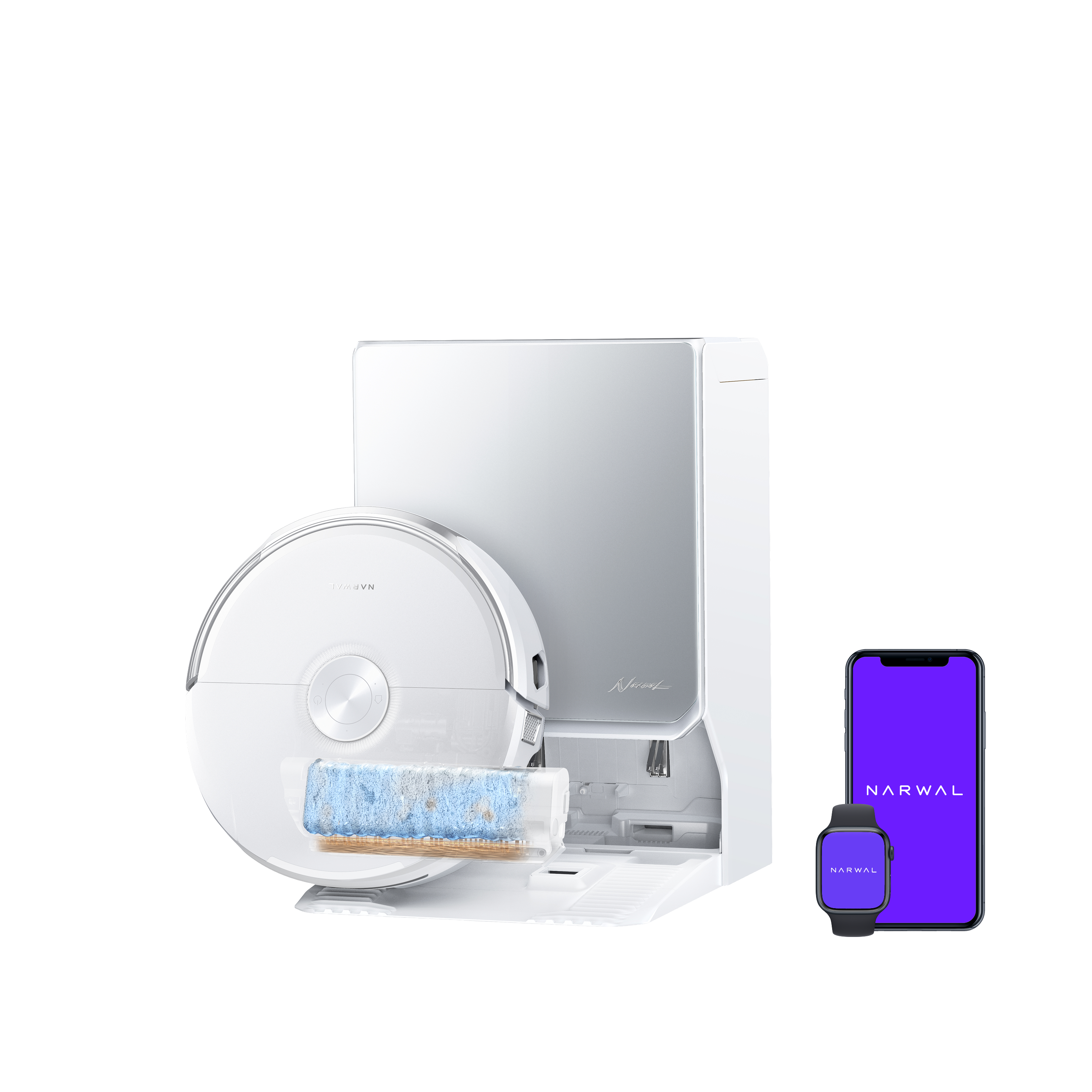
Explore this need in the finder →The Narwal Flow 2 is a robot vacuum-mop built around a moving track mop that refreshes as it travels and a self-cleaning charging dock. The standard dock automates dust emptying and mop washing and drying, but it still has removable water tanks and needs household attention. This assessment covers the documented basic-dock configuration, not every differently equipped bundle in Narwal’s listing.
Start with the basic dock configuration
The page-linked Flow 2 manual identifies robot YJCC036 and Self-cleaning Charging Dock YJCB036BH. Its specifications include both 100–127 V and 220–240 V station inputs, so this exact basic-dock manual does document a North American voltage range; check the unit nameplate and exact carton before connecting any purchase. The manual also describes clean- and dirty-water tanks, a cleaning-solution reservoir and a dust bag. The standard setup does not require fixed water and drain connections, but its tanks and station still need service.
The manual lists four robot modes: vacuum only, mop only, vacuum and mop together, and vacuum first followed by mopping. The base station empties the robot’s debris into its bag, then washes and dries the mop after the final mopping pass. “Self-cleaning” is not “maintenance-free”: tanks, solution, bag replacement and dock cleaning remain owner tasks.
A continuously refreshed track mop is the main distinction
Narwal describes FlowWash as a rolling track mop that is rinsed while the robot moves, rather than spinning pads or a flat cloth. The dock then washes and dries it. That matters if you want fewer manual pad changes, but does not prove how well it removes a particular stain.
The exact page promotes warm or hot FlowWash water, but its figures do not agree: one specification says 113°F, other copy says 140°F, and the station descriptions give a 113–176°F adaptive wash range alongside a 212°F graphic. The manual confirms water heating but does not resolve those figures. If a minimum mop-water or dock-wash temperature is essential, wait for Narwal to clarify which figure applies to each stage. The Freo X10 Pro uses dual spinning pads; the Freo 20 is another track-mop design, but their docks and packages are not interchangeable by assumption.
Carpet claims do not replace route measurements
Narwal lists up to 31,000 Pa suction and describes a retractable pressure plate for carpet cleaning. These are manufacturer claims, not a comparative pickup test. The page says the mop lifts over carpet but gives inconsistent travel figures. The manual lists robot dimensions of 351.2 × 363.5 × 95 mm—about 13.8 × 14.3 × 3.74 inches. That nominal height leaves little room under a four-inch opening; measure the lowest point, including rugs and floor transitions. No inspected source gives a maximum threshold height or numerical high-pile limit, so those needs remain unconfirmed.
The listed basic dock is sizable at 450 × 360 × 530 mm and weighs 10 kg. Narwal’s setup instructions call for at least 0.45 m of clear space in front of the station so the robot can enter and leave. Check the footprint and approach space before choosing it.
Check the network and the exact bundle
The Flow 2 manual specifies 2.4-GHz Wi-Fi, not 5-GHz-only support. It lists a 14.4-V battery and a charging time of about three hours. Capacity is not a clean comparison point: the manual rates the battery at 6,500 mAh while Narwal’s page advertises 7,000 mAh. This assessment leaves a minimum-capacity match unknown rather than selecting the larger marketing figure. Its “up to 120 days” dust-bag interval is a usage-dependent estimate, not a service guarantee.
Narwal’s U.S. listing includes a basic-dock option, color choices, kit and S30 Pro bundle variants, plus a separate Flow 2 Auto Refill & Drainage System variant. The last option is a different dock configuration; the page-linked auto-refill manual inspected identifies YJCC026/YJCB026SL rather than the basic Flow 2 manual’s YJCC036/YJCB036BH. Do not transfer the basic station’s specifications to that plumbing package without a model-specific manual. The native product feed reports variants available while the live detail page displayed out of stock, so verify exact SKU and current seller availability. No price or exact Amazon item number is asserted.
Who should consider it—and who should wait
Consider the basic-dock Flow 2 if you want a refreshed track mop, automatic dust emptying and post-mop care, have room for a large station, and can use 2.4-GHz Wi-Fi. Look elsewhere if 5-GHz-only support, a temperature minimum, a high-pile limit or a threshold rating is essential; a pressure plate or mop-lifting claim does not answer those unknowns.
Read the separate Freo X10 Pro assessment if you are comparing a dual-pad mop, or the Freo 20 assessment for another Narwal track-mop design. Their exact manuals and dock configurations differ. Choose the specific robot-and-station package your home can accommodate, not the largest number or hottest temperature in a promotional panel.
Key details at a glance
| Manufacturer-listed maximum suction | 31000 Pa |
|---|---|
| Robot height | 3.74 in |
| Manufacturer-reported dock dimension sequence (axes unspecified) | [17.72, 14.17, 20.87] |
| Mop system | Real-time refreshed roller mop |
| Warm water supplied for the robot's mop cycle | Yes |
| 2.4 GHz Wi-Fi supported | Yes |
| 5 GHz Wi-Fi supported | No |
| Dock water hookup | Removable dock water tanks |
| Fixed water supply and drain required | No |
| Dock empties dust automatically | Yes |
| Maximum manufacturer-claimed base dust capacity window | 120 days |
Use the exact model’s instructions for operating limits, supplied equipment and version differences.
Sources for this assessment

Check the fit before choosing the dock.
Compare your furniture clearance, network, floors and the work the station still asks you to do.