
Your needs, this model
Does it fit your priorities?
Does the robot fit a measured 4.00-inch opening?
Dreame lists the robot at 3.82 inches tall. Check the lowest brace, trim and floor/rug transition; that dimension is not a route guarantee.
Explore this need in the finder →Does the maker-list 2-cm crossing limit cover your threshold?
The product table lists 2 cm as a maximum. A higher essential step is beyond its documented claim, and a maximum is not a route guarantee.
Explore this need in the finder →Do you require the TriCut Brush 3.0 design?
The exact FE specification names TriCut Brush 3.0, a blade-based system Dreame describes as cutting wrapped hair. It is a manufacturer feature, not an independent anti-tangle result.
Explore this need in the finder →Must the dock publish a 100°C mop-wash claim?
Dreame lists 100°C hot-water mop-pad washing. Its family footnote relates this to the heated washboard under stated ambient test conditions; it does not establish 100°C water on the floor.
Explore this need in the finder →Can the dock location provide 2.4-GHz Wi-Fi?
The exact U.S. manual says the robot does not support 5-GHz Wi-Fi. A 2.4-GHz network is needed where the base will sit.
Explore this need in the finder →Must mop holders come off before the robot vacuums carpet?
No. The FE lifts pads by up to 10.5 mm but lists automatic mop removal as unavailable.
Explore this need in the finder →Do you need a numeric supported carpet-pile height?
No maximum pile height is published for the FE; unknown support cannot meet an essential pile-depth requirement.
Explore this need in the finder →Does the dock need to use removable tanks rather than fixed plumbing?
The standard FE base has removable 4.5-L clean and 4.0-L used-water tanks. Owners still have to fill and empty them.
Explore this need in the finder →Must water be warm during the robot mop cycle?
The 100°C claim applies to the dock wash system, not water delivered during mopping; the floor-water temperature is not published.
Explore this need in the finder →Would automatic pad washing and drying matter more than a compact charging-only dock?
The included station washes and hot-air dries two rotating pads, auto-empties dust and refills the robot. The user still services the removable tanks and tray.
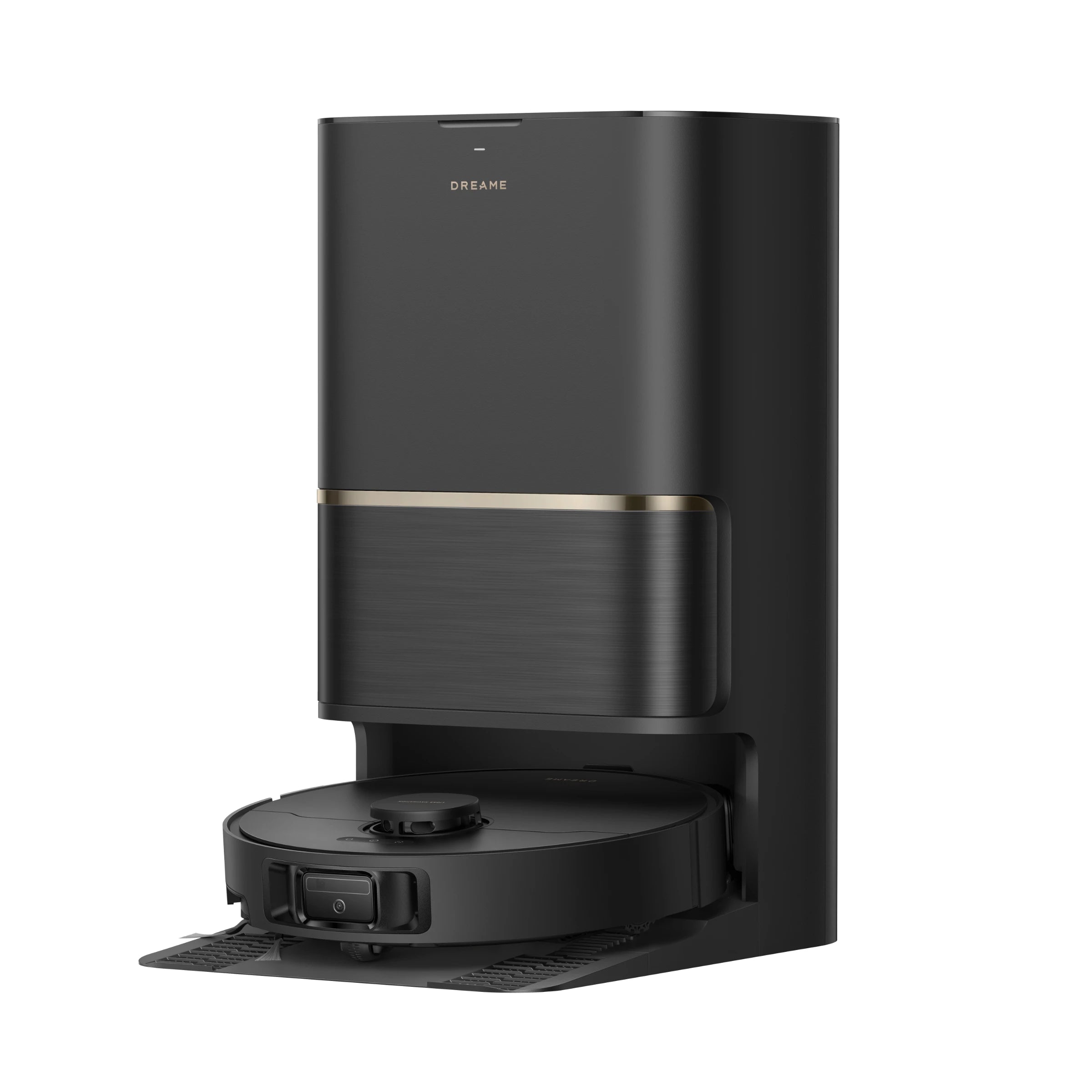
Explore this need in the finder →The Dreame L60 Ultra FE is a U.S. robot-and-base package, not just a robot name: its manual identifies robot RLL51SE and supply unit RCLE0563. Dreame’s U.S. product record lists white SKU 010204AA001367 and black SKU 010204AA001368 as color variants of the same package. The useful distinction is its combination of a TriCut brush and a full service station; the tradeoff is a more limited published route and carpet profile than the higher L60 models.
Measure the route before the feature list
Dreame lists the robot at 13.78 inches across and 3.82 inches tall, with a maximum threshold-crossing claim of 0.79 inch (2 cm). Those numbers answer two practical questions: whether the body fits under the furniture you measured, and whether a threshold is within the maker’s stated limit. A 3.5-inch opening is below its listed height, while a taller step than 2 cm is beyond its published crossing claim. A quoted maximum is not a promise for every ledge, rug edge, approach angle or floor transition, so measure the whole path and leave margin.
The FE uses LDS navigation and single-laser 3D structured-light obstacle sensing. The product comparison does not list a recognized-object count or camera-based object-identification system for it, and the sensor is not described as retractable. If a low brace is the deciding obstacle, compare the robot’s full 3.82-inch listed height with the smallest point along the route rather than assuming its sensor will lower.
The TriCut brush is the defining floor-care choice
The main brush is Dreame’s TriCut Brush 3.0. The maker describes its blades as cutting wrapped hair, a different strategy from the HyperStream dual-brush arrangements used on other L60 models. That is a meaningful feature for hair-prone floors, but a brush design and the manufacturer’s anti-tangle claims are not independent tests: hair length, carpet weave and maintenance can still affect what needs clearing. The FE is listed at up to 30,000 Pa, another manufacturer maximum rather than a measured pickup result.
Its two rotating Omni-Scrub pads can extend outward, and Dreame lists a 4-cm edge reach and 10.5-mm mop lift. The station washes and dries the pads, but the specification marks automatic mop removal unavailable and the robot does not lift its main brush. A lifted pad is not a detached pad. If carpet care depends on physically removing the mop assemblies or raising the main brush, choose a configuration that documents those actions instead.
Automation still leaves a water-and-care routine
The included base auto-empties dust, washes the mop pads with a stated 212°F (100°C) hot-water dock claim, dries them with hot air and refills the robot’s water box. Dreame describes its 100°C figure as a washboard heating-system temperature reached under specified ambient test conditions; it can vary and is not a promise that water delivered to the floor is 100°C. The manual says to add clean water, not hot water, to the clean-water tank. If warm floor mopping or a verified minimum mop-water temperature is essential, this product’s dock-wash claim does not meet that need.
The dock uses removable 4.5-L clean- and 4.0-L used-water tanks, so the standard package needs space for the station and access to fill and empty the tanks. The manual lists a single-compartment solution dispenser and says to use the approved L60 Ultra FE cleaning fluid; the U.S. product page includes the dispenser and a 200-ml solution bottle in its package list. It also lists a 3.2-L dust bag and an “up to 100 days” emptying claim. Treat that as a maker capacity estimate, not a household schedule. Tank checks, filter and tray cleaning, and bag replacement remain owner jobs.
Network, power and carpet boundaries
The exact English U.S. manual identifies RLL51SE and RCLE0563, requires a properly grounded nominal 120-V circuit, and says the robot supports 2.4-GHz Wi-Fi rather than 5 GHz. This is an app-connected system, so a 5-GHz-only network where the base sits is a mismatch. Dreame lists a 5,200-mAh battery, but that figure alone does not tell you how much of your floor plan it can clean on one charge; the page gives no independent room-size or mixed-mode runtime result.
The product page describes automatic carpet strategies and says the pads lift 10.5 mm, but it does not publish a maximum supported pile height. Unknown pile support should not pass a strict carpet-depth requirement. Measure rugs and edges, and do not infer that carpet detection makes every textile safe for vacuuming and mopping.
Who should shortlist the FE?
Consider it when you want a robot that vacuums and mops with rotating pads, value the TriCut hair-handling design, have a 2.4-GHz network, can manage removable tanks, and have low transitions that fit the 2-cm maker claim. Its automatic pad care and dust emptying reduce daily handling but do not remove routine maintenance.
Move up to the Dreame L60 Pro Ultra if its documented retractable navigation sensor, different brush system, automatic mop removal or higher conditional step claims solve a measured problem. Its two-layer figure has a stated lower-step landing-width condition; it is not a universal threshold promise. If those features do not address an actual need, the FE’s TriCut brush and tank dock may be enough. Choose against the floor plan, network and care routine—not a suction headline alone.
Key details at a glance
| Manufacturer-listed maximum suction | 30000 Pa |
|---|---|
| Robot height | 3.82 in |
| Robot weight | 8.88 lb |
| Manufacturer-reported dock dimension sequence (axes unspecified) | 18.0 × 13.39 × 23.23 in (W × D × H) |
| Published dock mop-cleaning temperature claim | 100 °C |
| Maximum manufacturer-listed threshold claim | 2 cm |
| Battery capacity | 5200 mAh |
| Mop system | Dual spinning or rotating mop pads |
| Dock clean-water tank | 4.5 L |
| Dock dirty-water tank | 4 L |
| LiDAR retracts under low furniture | No |
| 2.4 GHz Wi-Fi supported | Yes |
| 5 GHz Wi-Fi supported | No |
| Dock water hookup | Removable dock water tanks |
| Fixed water supply and drain required | No |
| Dock empties dust automatically | Yes |
| Maximum manufacturer-claimed base dust capacity window | 100 days |
Use the exact model’s instructions for operating limits, supplied equipment and version differences.
Sources for this assessment
- Dreame U.S. L60 Ultra FE product page and package list
- Dreame U.S. native L60 Ultra FE product and variant record
- Dreame U.S. robot-vacuum current directory, exact L60 Ultra FE row
- Dreame North America L60 Ultra FE support article
- Dreame North America exact L60 Ultra FE manual attachment metadata
- Dreame Robot Vacuum L60 Ultra FE Manual
- Dreame U.S. L60 series comparison page
- Exact Black L60 Ultra FE U.S. product-page render
- Exact White L60 Ultra FE U.S. product-page render
- SaferProducts exact-title recall query


Check the fit before choosing the dock.
Compare your furniture clearance, network, floors and the work the station still asks you to do.