
Your needs, this model
Does it fit your priorities?
Will the dock location have a usable 2.4 GHz Wi-Fi network?
The US-A00 manual supports 2.4 GHz only and explicitly says 5 GHz is unsupported. A 5 GHz-only network is not a fit unless another supported 2.4 GHz network reaches the station.
Explore this need in the finder →Is a 75°C dock mop-wash claim enough, or do you require a higher published temperature?
Dreame publishes up to 75°C/167°F for pad washing at the base-station outlet under stated conditions; actual temperature may vary. This is not floor-water temperature, and an 80°C minimum is not met by the published claim.
Explore this need in the finder →Is the single-step maximum claim sufficient for the transitions the robot must cross?
Use the separately qualified 40 mm claim only for a two-layer step with more than 1.18 inches between rises. For a single step, Dreame lists 22 mm/0.87 inches; a 3 cm minimum is not documented.
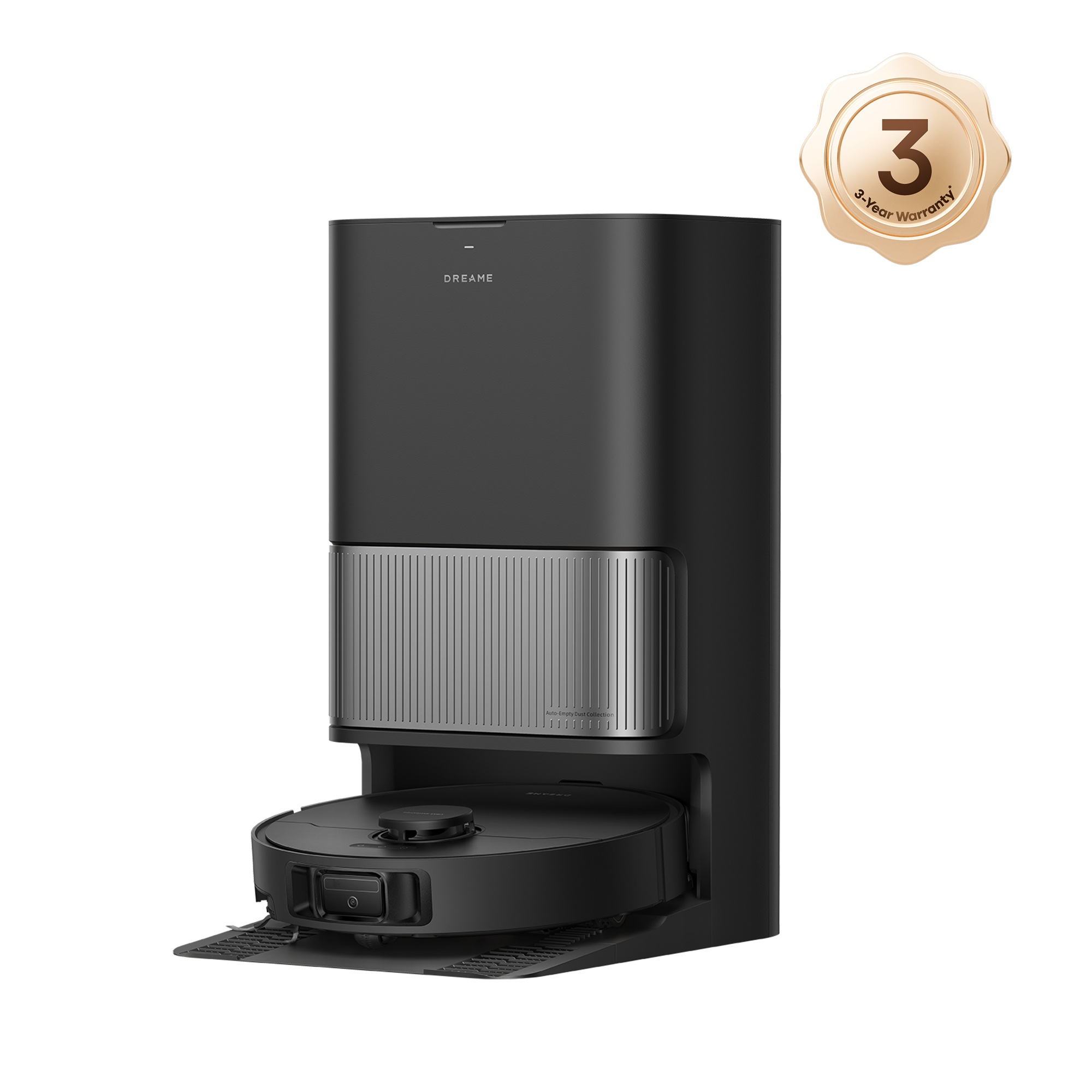
Explore this need in the finder →The Dreame L40s Ultra is the standard U.S. version in Dreame’s L40s family—not the L40s Ultra AE or CE. Its exact U.S. manual identifies the robot as RLL22SE and the matching base/supply unit as RCLE0305. The U.S. product record lists two finishes: black SKU 010204AA000823 and white SKU 010204AA000742. The black image shown here is Dreame’s exact black-variant studio render; its decorative warranty badge is artwork, not evidence of coverage terms. Both variants were marked available in the captured U.S. catalog on October 24, 2026; that dated observation is not a promise of future stock.
Read the threshold figure as two different claims
Dreame lists maximum suction of 19,000 Pa and a HyperStream detangling DuoBrush. Those are maker specifications, not independent pickup or hair-tangle measurements. The product page names single-laser 3D structured-light obstacle avoidance; it does not establish a success rate on every cord, small toy or cluttered room. A first run still deserves supervision and a cleared floor.
The threshold table gives the L40s Ultra a 22 mm/0.87-inch single-step maximum and a separate 40 mm/1.57-inch double-layer maximum. Dreame’s footnote conditions the larger claim on a gap greater than 1.18 inches between the two rises, and it attributes the claim to its in-house testing. This is not a 4 cm single-doorway guarantee. For one ordinary sill, use the smaller claim as the relevant comparison; keep margin for the transition’s shape, approach and rug edge. If your route depends on a particular two-rise crossing, measure both rises and the intervening gap against the stated geometry before shortlisting it.
Choose its mop routine with the rugs in mind
The standard Ultra uses two spinning mop pads and can extend its mop, lift it by a listed 10.5 mm, or remove the mop assembly. The manual describes vacuum-only, mop-only, combined vacuum-and-mop, and vacuum-then-mop modes. In vacuum-only use, the station automatically removes the mop mount; it installs the assembly for a mopping task. That gives a practical option for keeping wet pads off some rugs. It does not publish a maximum supported carpet-pile height, so automatic removal should not be mistaken for a tested shag-rug rating. A must-clean deep-pile rug remains an unverified fit.
That distinction also matters when comparing the family. Dreame’s own U.S. table gives the Ultra the qualified 40 mm double-layer claim, extending side brush and mop removal. The AE is listed with the same 19,000 Pa suction figure but without mop removal or that crossing claim; the CE has a different TriCut brush and a lower 13,000 Pa listed maximum. The sibling names are not interchangeable package identities. If mop removal or the conditional crossing geometry is essential, confirm the standard Ultra and its exact RLL22SE/RCLE0305 package rather than buying from a similar-looking family listing.
The station saves chores, but does not remove them
The included station auto-empties the robot, washes and hot-air dries the pads, self-cleans its washboard, adds approved solution and refills the robot from removable tanks. Dreame lists 4.5 L clean-water and 4.0 L used-water capacity, plus a 3.2 L dust bag and “up to 100 days” of auto-emptying. That last interval is a maker calculation based on its testing, not a household schedule; pet hair, dust and room use can change how often you service it.
The 75°C/167°F figure is for hot-water pad cleaning at the base station’s outlet, under Dreame’s stated room conditions; the manufacturer says the temperature may vary. It is not the temperature of water put on your floor. The manual says to use clean—not hot—water in the tank and only the specified Dreame cleaning solution. Plan to lift and empty the used-water tank and clean the washboard and other parts on the manual’s schedule. The standard U.S. setup is a removable-tank dock, not an included fixed-plumbing installation.
Check the space, outlet and network first
Dreame lists the base at 13.39 × 17.99 × 23.23 inches and the robot at 13.78 inches across and 3.82 inches tall. The manual’s setup diagram asks for more than 39 inches clear in front and more than 2 inches on both sides; those paths matter in addition to the dock body’s footprint. The RCLE0305 manual specifies a grounded nominal 120 V circuit and says not to use an adapter. It also limits app setup to 2.4 GHz Wi-Fi; a 5 GHz-only network at the station is a hard mismatch unless a compatible 2.4 GHz network is available. The manual gives an approximate 3.5-hour charge time, while Dreame’s up-to-220-minute claim is for quiet-mode vacuuming in its own test and should not be read as mixed-mode runtime.
Who should shortlist the L40s Ultra?
Consider this exact package if you want a dual-pad robot with automatic mop removal for vacuum-only runs, a wash-and-dry station, and both a conventional 22 mm single-step claim and a separate geometry-qualified double-step claim. It is a poor fit if only 5 GHz Wi-Fi is available, if a 3–4 cm single sill is essential, if you require fixed plumbing as standard, or if you need a published maximum carpet-pile rating. You also need room for the large station and willingness to maintain water tanks and wash parts.
Sources and limits
This assessment uses Dreame’s U.S. L40s Ultra product page, its L40s family comparison, the L40s Ultra US-A00 user manual, and the exact row and finish IDs in Dreame’s current U.S. robot-vacuum collection. The linked page and manual confirm the RLL22SE robot, RCLE0305 base, electrical data, 2.4 GHz limit and mode-specific mop removal. All suction, threshold, temperature, duration, dimensions and battery figures above are manufacturer statements, not independent lab measurements; none guarantees a result in your home.
Key details at a glance
| Manufacturer-listed maximum suction | 19000 Pa |
|---|---|
| Robot height | 3.82 in |
| Robot weight | 9.04 lb |
| Manufacturer-reported dock dimension sequence (axes unspecified) | {'width': 13.39, 'depth': 17.99, 'height': 23.23} |
| Published dock mop-cleaning temperature claim | 75 °C |
| Maximum manufacturer-listed threshold claim | 2.2 cm |
| Battery capacity | 5200 mAh |
| Mop system | Dual spinning or rotating mop pads |
| Dock clean-water tank | 4.5 L |
| Dock dirty-water tank | 4 L |
| 2.4 GHz Wi-Fi supported | Yes |
| 5 GHz Wi-Fi supported | No |
| Dock water hookup | Removable dock water tanks |
| Fixed water supply and drain required | No |
| Dock empties dust automatically | Yes |
| Maximum manufacturer-claimed base dust capacity window | 100 days |
| Conditional two-step threshold claim | 4 cm |
Use the exact model’s instructions for operating limits, supplied equipment and version differences.
Sources for this assessment
- Dreame U.S. L40s Ultra product page and specifications
- Dreame U.S. L40s Ultra native product and finish record
- Dreame U.S. robot-vacuum collection, exact L40s Ultra row
- Dreame L40s Ultra US-A00 user manual
- Dreame U.S. L40s family comparison
- Exact black Dreame L40s Ultra U.S. variant image
- CPSC SaferProducts bounded recall query for robot model RLL22SE
- CPSC SaferProducts bounded recall query for Dreame L40s Ultra name

Check the fit before choosing the dock.
Compare your furniture clearance, network, floors and the work the station still asks you to do.