
Your needs, this model
Does it fit your priorities?
Can a compatible 2.4 GHz Wi-Fi network reach the station?
The US-A00 manual supports only 2.4 GHz and explicitly says the robot does not support 5 GHz; a 5 GHz-only site is not confirmed.
Explore this need in the finder →Is a 2 cm single-step maximum enough, rather than a 3 cm minimum?
Dreame lists a 20 mm maximum for the CE; a 3 cm single-step requirement is not met by that claim.
Explore this need in the finder →Do you require dual spinning mop pads rather than a vacuum-only robot?
The exact U.S. family comparison lists dual spinning mop pads for the CE; it is not a vacuum-only configuration.
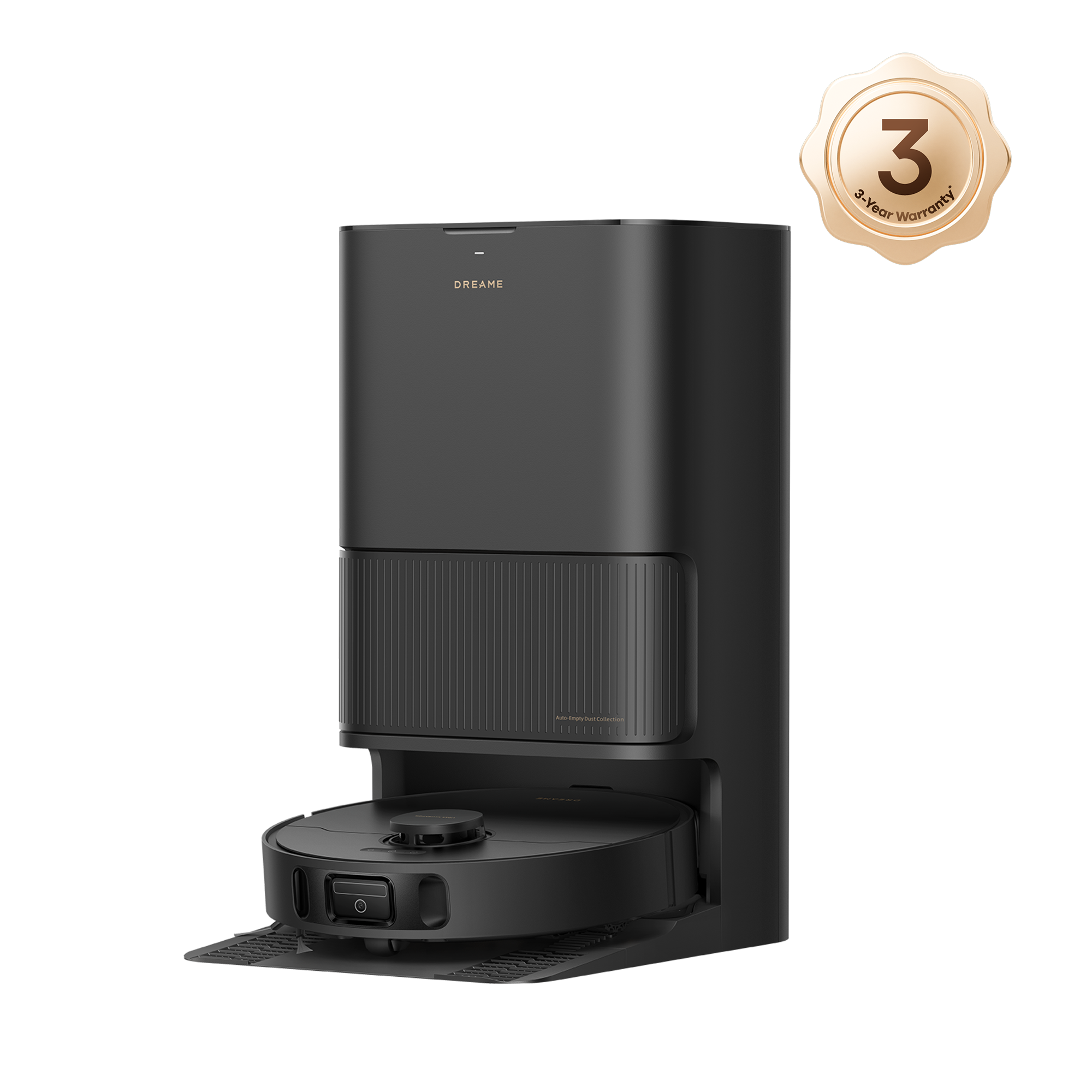
Explore this need in the finder →The Dreame L40s Ultra CE is the more basic U.S. package in the L40s Ultra family; it is not the AE in a different color. The exact US-A00 manual identifies robot RLD52SE and base RCDE0302. Dreame’s native U.S. record lists white SKU 010204AA000854 and black SKU 010204AA000788. The lead image here is the exact black robot with its matching black station. Its warranty emblem is part of the image, not proof of coverage terms. The captured listing marked both finishes available on the recorded date, not as a continuing stock guarantee.
Where the CE trims the L40s formula
Dreame lists maximum suction of 13,000 Pa for the CE, below the 19,000 Pa figures it publishes for the standard L40s Ultra and AE. These are maker specifications based on its own tests, not comparative pickup scores. The CE has a TriCut main brush and dual spinning mop pads, but the U.S. page does not identify its brush as TriCut Brush 3.0. If the exact version matters, do not substitute the AE’s included alternate brush or a shared family description.
The robot is listed at 104 mm / about 4.09 inches tall, with a 20 mm maximum threshold claim. The height is a nominal body measurement; it does not guarantee that it will clear furniture with rugs, trim or uneven floors underneath. The 20 mm figure is a manufacturer maximum, not a route guarantee. It does not make the CE a fit for a 3 cm single step, and the U.S. comparison does not give it the standard model’s separate geometry-qualified 40 mm two-layer claim. Check your actual route rather than transferring a number from the standard L40s.
For navigation, the manual identifies an LDS and 3D line-laser sensor. Dreame’s page describes its 3DAdapt obstacle-avoidance feature, but no exact CE camera-object count or independent avoidance rate is established here. Keep cords and small objects off the floor and follow the robot during initial runs; a named sensor cannot promise it will avoid every obstacle.
A wash-and-dry dock without the standard model’s heated wash claim
The CE still has a substantial station: it auto-empties dust, washes and dries the pads, and refills the robot from removable tanks. Dreame lists 4.5 L clean-water and 4.0 L used-water capacity, a 3.2 L dust bag and a 320 ml robot dust box. The exact U.S. comparison lists dual spinning pads and the RoboSwing feature. It does not list mop extension or automatic removal of the mop mount. Dreame lists a 10.5 mm mop lift, but a lifted pad is not a maximum carpet-pile rating. No numeric pile-height limit is published for this exact CE. If you need the robot to cross deep rugs safely or leave its mop assembly at the station during vacuuming, that remains an unconfirmed fit.
A product-table slash distinguishes the CE from the standard model and AE on hot-water pad washing and self-cleaning washboard. The CE source set does not publish a numeric dock wash temperature, so a 75°C requirement must filter it out; do not infer heat from the wash-and-dry feature. Nor is there a published temperature for water delivered while mopping the floor. The manual says to use clean water and not add hot water to the clean-water tank. The solution dispenser is a separate purchase for CE, so its capabilities should not be described as part of the included station.
Tank capacity does not mean no maintenance. Empty used water, wash removable parts, replace the dust bag and keep the washboard, sensors and mop surfaces clean on the manufacturer’s schedule. The station has no documented fixed water-supply or drain connection in this U.S. package; the normal routine means filling and emptying tanks by hand.
Setup is still app-and-network dependent
The manual specifies a grounded nominal 120 V circuit, 60 Hz, 4.1 A input during dust emptying and 20 V DC / 2 A output. It gives an approximate 3.5-hour charge time and supports only 2.4 GHz Wi-Fi; 5 GHz is explicitly unsupported. If the intended dock site only receives 5 GHz, this is not a suitable shortlist result unless a compatible 2.4 GHz network is also available. A water-supply or app requirement should be checked before committing to a location, not after moving the station and robot around the home.
Choose by routine, not by the family name
The CE can make sense for a shopper who wants the dual-spinning-pad routine and an automatic dust-emptying, pad-washing and drying station, but does not require a numeric hot-water wash claim, included detergent dispenser, camera recognition or the top L40s suction figure. Its 2 cm single-step claim, lower body height than the AE, washable mop system and tank-based station form a clear package; it is still a large dock that needs manual tank service.
Choose the AE instead if a 75°C dock pad-wash claim, camera plus dual-line laser arrangement or included TriCut Brush 3.0 alternate are priorities. The standard L40s Ultra has 19,000 Pa listed suction, automatic mop-mount removal and the family’s qualified 40 mm double-layer claim, but those details must be verified on that exact RLL22SE / RCLE0305 model. The CE should not be recommended for a 5 GHz-only setup, a 3 cm single threshold, a 75°C pad wash, fixed plumbing, automatic mop removal, or a must-clean rug with a published pile-height ceiling. Unknown is not a positive match.
Sources and limits
This review uses Dreame’s U.S. L40s Ultra CE page, the L40s family comparison, its US-A00 manual listing and linked manual PDF, and Dreame’s native U.S. collection record. The exact package links RLD52SE to RCDE0302 and to the black/white SKUs above. Suction, capacity, height, lift and threshold numbers are manufacturer claims, not independent measurements. The numeric dock-wash and floor-water temperatures, high-pile limit, camera object count, fixed plumbing and exact TriCut version remain unconfirmed.
Key details at a glance
| Manufacturer-listed maximum suction | 13000 Pa |
|---|---|
| Robot height | 4.09 in |
| Robot weight | 8.6 lb |
| Manufacturer-reported dock dimension sequence (axes unspecified) | {'width': 13.39, 'depth': 17.99, 'height': 23.23} |
| Maximum manufacturer-listed threshold claim | 2 cm |
| Battery capacity | 5200 mAh |
| Mop system | Dual spinning or rotating mop pads |
| Dock clean-water tank | 4.5 L |
| Dock dirty-water tank | 4 L |
| 2.4 GHz Wi-Fi supported | Yes |
| 5 GHz Wi-Fi supported | No |
| Dock water hookup | Removable dock water tanks |
| Fixed water supply and drain required | No |
| Dock empties dust automatically | Yes |
| Maximum manufacturer-claimed base dust capacity window | 100 days |
Use the exact model’s instructions for operating limits, supplied equipment and version differences.
Sources for this assessment
- Dreame U.S. L40s Ultra CE product page and specifications
- Dreame U.S. L40s Ultra CE native product and finish record
- Dreame U.S. robot-vacuum collection row for L40s Ultra CE
- Dreame L40s Ultra CE U.S. US-A00 user manual
- Dreame U.S. L40s family model comparison
- CPSC SaferProducts bounded model recall query for RLD52SE
- CPSC SaferProducts bounded product-name query for L40s Ultra CE
Check the fit before choosing the dock.
Compare your furniture clearance, network, floors and the work the station still asks you to do.