
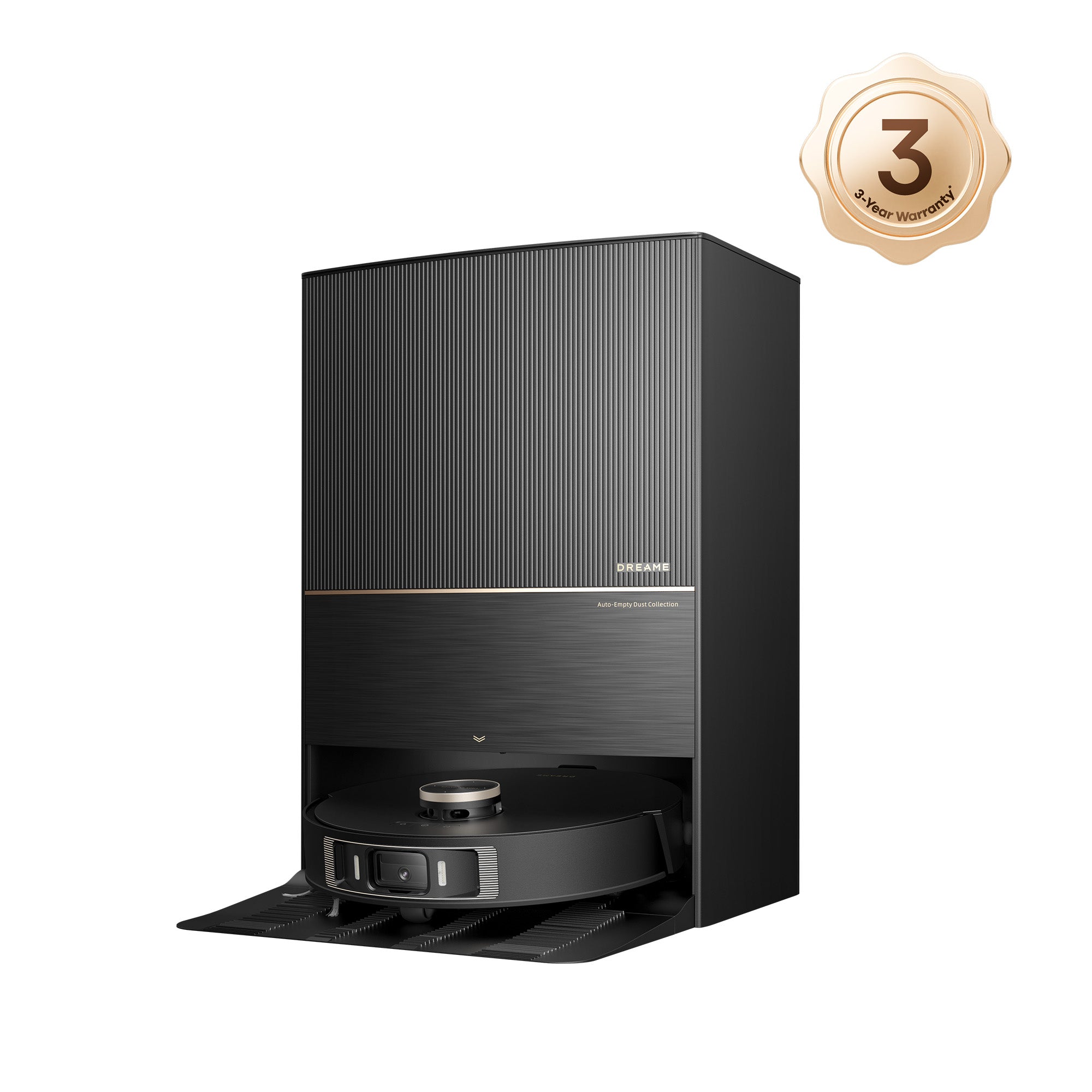
Your needs, this model
Does it fit your priorities?
Will the robot pass beneath a measured 4.25-inch opening, or is a 4.00-inch opening essential?
Use the 103.8 mm metric height (about 4.09 in) rather than the rounded 4-inch label. A 4.25-inch opening has a nominal margin; a 4.00-inch opening is below the published metric figure, and actual floor clearance should still be measured.
Explore this need in the finder →Does the maker's 2 cm maximum threshold-crossing claim cover your route, or do you require a 3 cm claim?
Dreame lists a 2 cm maximum; it is not a guarantee for every threshold profile. A 3 cm essential requirement is not documented for this model.
Explore this need in the finder →Do you want two rotating pads, or is a continuously refreshed roller essential?
This model uses two rotating pads. It does not use a continuously refreshed roller.
Explore this need in the finder →Can the base connect to a 2.4 GHz Wi-Fi network, or is 5 GHz the only available band?
The U.S. manual supports 2.4 GHz only and says 5 GHz is unsupported.
Explore this need in the finder →Do you need an explicit manufacturer carpet-pile support limit?
Dreame advises avoiding carpet or removing the mop assembly when pile exceeds 7 mm, but does not give a positive maximum supported pile rating. If a documented high-pile limit is essential, do not treat the 10.5 mm pad lift as a substitute.
Explore this need in the finder →Can you manage removable water tanks, or must the included dock use fixed plumbing?
The standard U.S. RCXE2 package uses removable tanks. A water hookup kit is a separate accessory and is not included in this plan.
Explore this need in the finder →Do you want the base to remove mop pads before carpet vacuuming, or is a documented carpet-pile support limit essential?
The L20 can return to its base and detach its mop assembly for vacuum-only work when enabled in the app. Dreame advises avoidance or pad removal above 7 mm pile but gives no positive high-pile support rating.
Explore this need in the finder →The U.S.-listed L20 Ultra combines an RLX41CE robot with an RCXE2 base. Dreame’s native record shows one default-title offer, SKU 010204AA000272; the U.S. manual names both codes and requires a grounded 120-volt circuit. The page was marked sold out when checked, so this review promises neither stock nor price. Search the exact “Dreame L20 Ultra Robot Vacuum” name, not the later Complete model or another regional package.
Measure the robot and the place it will live
Dreame lists a roughly 13-inch footprint and a rounded 4-inch height, but its dimension field is malformed. The same page’s metric comparison gives 350 × 350 × 103.8 mm. Use 103.8 mm (about 4.09 inches) for a first clearance check, then measure your opening and allow for uneven floors. A nominal 4-inch gap is too tight on the published figure; this is not the low-profile choice for deep furniture.
The larger base measures 23.8 × 16.7 × 19.6 inches and weighs 29.3 pounds. The manual calls for 60 inches clear in front and 2 inches on each side. Leave additional space to lift both tanks and open the station. Keep it within reach of the needed outlet and Wi-Fi.
Its carpet feature is physical mop removal—not just lifting
The L20 uses two rotating mop pads and can raise them up to 10.5 mm, but its more distinctive mixed-floor option is the ability to park the mop assemblies back at the base before vacuum-only cleaning. The U.S. product page says carpet detection can send the robot back to the station to detach the mops when that setting is enabled; Dreame says mop removal is off by default. Set it in the app and confirm the behavior before relying on it around rugs. The manual also describes separate vacuum-only, mop-only, vacuum-then-mop and vacuum-and-mop modes.
Physical removal can keep the pads off carpet while preserving a two-pad routine on hard floors. It is not a refreshed roller, a vibrating cloth or a guarantee that every rug stays dry. Dreame advises avoiding carpet or removing pads above 7 mm pile, yet gives no positive high-pile rating. The 10.5 mm lift is not a pile-height specification. For deep carpet, choose a model with a stated support limit.
What the station handles—and what it leaves to you
The base empties dust into a 3.2-liter bag, washes and warm-air dries pads, and refills the robot’s small tank. Dreame’s “up to 75 days” bag estimate is an in-house calculation that varies with use. The station has 4.5-liter clean- and 4-liter used-water tanks. You still fill, empty, change the bag and clean the washboard; the manual recommends washing the used-water tank after each use.
A fixed water hookup is not standard equipment. The manual describes an optional refill-and-drain kit, sold separately and available only in specific regions. Treat the ordinary U.S. package as a removable-tank dock unless the exact offer and included kit are independently established. Dreame’s page says the station adds its cleaning solution automatically, and the in-box list includes a bottle; the manual says to use only the intended Dreame fluid and not to add hot water to the clean-water tank. Hot-water pad washing is a dock function, not evidence that hot water is used on the floor.
Separate maker ratings from household guarantees
Dreame lists 7,000 Pa suction and a 2 cm maximum threshold claim; neither is an independent test or a guarantee for every threshold shape. The robot combines LDS navigation, an AI visual sensor and line lasers. Its 55-object recognition figure is a maker calculation, not a promise that it avoids every cord or fragile item. Clear the route and set no-go zones where needed.
Dreame claims up to 210 minutes for vacuum-only or mop-only and 180 minutes for combined cleaning, all in Quiet mode—not a forecast for every home. Numeric filters also need care: one page block lists a 6,400 mAh battery, another 5,200 mAh; the dust box is called 300 mL in a feature callout and 350 mL in specifications. The U.S. manual settles neither conflict, so both capacities remain unconfirmed.
Who should shortlist the L20 Ultra?
Consider it for hard floors and low-pile rugs if you have 2.4 GHz Wi-Fi, room for a full-size washing station and time for tank care. The detachable holders distinguish it from the L40 Ultra Gen 2, whose reviewed U.S. package has rotating pads but no documented automatic mount removal. That model has a different robot, dock and 25,000 Pa maker suction claim—not proof of better pickup. Choose for the needed feature, not the bigger number.
Pass on this L20 if a 4-inch opening is a hard requirement, a 3 cm threshold claim is essential, your network is 5 GHz only, you need a documented deep-carpet limit, or fixed plumbing must be included. For a current purchase, verify the exact name and what is in the box; the U.S. manufacturer page is presently marked sold out. Dreame’s U.S. L20 Ultra listing and its U.S. owner manual are the useful checks for the package and setup.
Key details at a glance
| Manufacturer-listed maximum suction | 7000 Pa |
|---|---|
| Robot height | 4.09 in |
| Robot weight | 9.5 lb |
| Manufacturer-reported dock dimension sequence (axes unspecified) | 23.8 × 16.7 × 19.6 in as listed; axis order is not specified |
| Maximum manufacturer-listed threshold claim | 2 cm |
| Mop system | Dual spinning or rotating mop pads |
| Dock clean-water tank | 4.5 L |
| Dock dirty-water tank | 4 L |
| LiDAR retracts under low furniture | No |
| Manufacturer-listed object-recognition types | 55 types |
| 2.4 GHz Wi-Fi supported | Yes |
| 5 GHz Wi-Fi supported | No |
| Dock water hookup | Removable dock water tanks |
| Fixed water supply and drain required | No |
| Dock empties dust automatically | Yes |
| Maximum manufacturer-claimed base dust capacity window | 75 days |
Use the exact model’s instructions for operating limits, supplied equipment and version differences.
Sources for this assessment

Check the fit before choosing the dock.
Compare your furniture clearance, network, floors and the work the station still asks you to do.