
Your needs, this model
Does it fit your priorities?
Is the Wi-Fi at the dock location 2.4 GHz, or is 5 GHz the only available band?
D30 Ultra's manual supports 2.4 GHz and expressly excludes 5 GHz; a 5-GHz-only home is a mismatch.
Explore this need in the finder →Do your thresholds fit the manufacturer's 20 mm maximum claim, or do you need a 30 mm minimum?
Dreame lists up to 20 mm; a 30 mm essential minimum is not documented for this robot.
Explore this need in the finder →Do you specifically want two rotating mop pads rather than a continuously refreshed roller?
The product page describes two high-speed rotary mop pads; this is not a roller-mop system.
Explore this need in the finder →Can you accept the removable-tank routine, or is fixed plumbing essential?
The included RCDE0101 station uses clean and used water tanks that the owner fills and empties; it is not a fixed-supply/drain plan.
Explore this need in the finder →Is explicit support for high-pile carpeting essential to your floor plan?
Dreame lists carpet settings and 10.5 mm mop lifting but provides no positive high-pile depth limit; an essential high-pile requirement should reject this model.
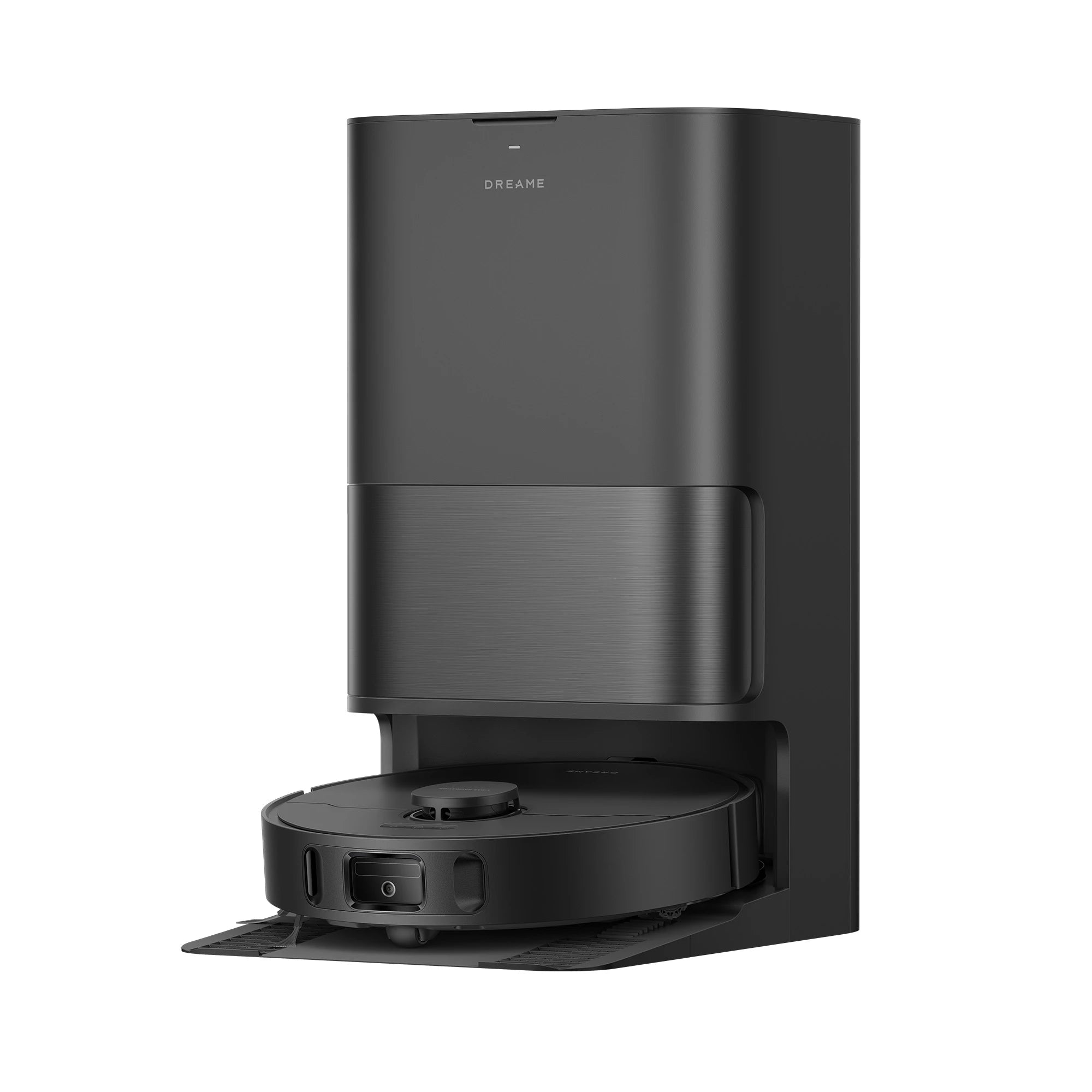
Explore this need in the finder →The U.S. Dreame D30 Ultra is a robot-and-PowerDock package, not just a vacuum with an optional station. Its English manual identifies robot RTD31TE and base station RCDE0101. The manufacturer’s U.S. product record lists black SKU 010204AA001320 and white SKU 010204AA001323; the assessment treats these finish-only variants together. The card image is the black product-page render, not a photograph of an owned unit.
Why choose its mop-and-station routine
D30 Ultra uses two rotating mop pads, not a continuously refreshed roller. Dreame calls the mechanism DuoScrub and says the pads spin at high speed under pressure. That distinction matters if you already know you prefer a roller, a vibrating cloth, or a simpler flat pad. The manual documents vacuum-only, vacuum-and-mop, vacuum-then-mop and mop-only modes. It also describes settings such as room maps, no-go zones and scheduled cleaning through the Dreamehome app. A robot button can start or pause a run, but mapping and the detailed routine are app-oriented.
The page publishes 25,000 Pa maximum suction and a TriCut hair-detangling brush. Those are manufacturer specifications and design claims, not a comparative pickup test. Its edge-reaching MopExtend feature is advertised as reaching into corners; the result depends on the room, furniture and settings, and the claim is not an independently measured coverage result. The same caution applies to the station’s “up to 100 days” dust capacity: the dock uses a 3.2 L bag, but household debris and cleaning frequency change how often it needs service.
What the PowerDock does—and what you still do
The included base automatically empties dust, washes the two mop pads and air-dries them. Dreame lists 4.5 L clean-water and 4.0 L used-water tanks. This is a removable-tank arrangement rather than a fixed supply-and-drain installation: the manual tells the owner to take the clean tank out and fill it, then remove and empty the used-water tank after a job. It cautions against putting hot water into the clean tank. The station does not remove the routine entirely; plan to rinse and empty its used-water parts and keep the washboard filter, pads and dust bag in usable condition. The manual’s maintenance table calls for checking the used-water tank after each use and gives replacement intervals for consumables, with frequency depending on actual use.
The page describes high-temperature spray nozzles for dock washing but does not give a numeric mop-wash temperature. Nor does it state that warm water is supplied to the robot for floor mopping. Do not translate a hot-water station-cleaning claim into a temperature claim at the pads. If a stated wash or floor-water temperature is an essential filter, this package does not document the number needed.
Check the room, Wi-Fi and floor transitions
The robot is listed at 350 × 350 × 97 mm, giving a stated height of about 3.81 inches. Measure the lowest furniture edge rather than relying on a product silhouette; this model will not fit a 3.50-inch clearance requirement. The official page lists a maximum threshold claim of 20 mm (0.79 inch). Treat that as the maker’s stated limit, not a guarantee for a sharp, slippery or unusually shaped sill. It is not a 3 cm or 4 cm crossing claim.
The manual says the robot supports 2.4 GHz Wi-Fi and explicitly does not support a 5 GHz connection. If the dock location is served only by 5 GHz, this is a decisive mismatch, even if the other features look appealing. The manual calls for an open station location with a good signal and recommends a grounded 120 V outlet. It describes setting up the Dreamehome app and creating a map after connecting to Wi-Fi. The product page shows carpet strategies and a 10.5 mm mop lift, but the sources reviewed do not specify a supported high-pile depth. Mop lift alone is not evidence that thick carpet is suitable; if high-pile support is essential, choose a model with an explicit positive carpet limit instead.
Who should look elsewhere?
This is a stronger fit for someone who wants rotating-pad scrubbing, automated dust disposal and pad washing/drying, has space for a fairly tall dock, can service removable water tanks, and has 2.4 GHz Wi-Fi where the base will sit. It is a poor match for a 5-GHz-only home, fixed-plumbing requirement, 3.5-inch furniture gap, minimum 3 cm threshold claim, or a need for a numeric wash-water temperature or published high-pile rating. If your priority is a roller mop that continually refreshes its working surface, compare the distinct eufy Omni C28 and E35 assessments; they use different mop and dock routines. The D30 Ultra should not be treated as the D30 Ultra CE: the manufacturer lists them as separate U.S. products with different model identifiers, and their similar names do not establish interchangeable hardware or manuals.
Source notes
This assessment uses Dreame’s exact U.S. D30 Ultra product page, its U.S. product/variant record, and the D30 Ultra English owner manual. The manual identifies RTD31TE and RCDE0101 and provides safety, setup, care, Wi-Fi and electrical information. All cleaning, suction, crossing and dust-duration figures above are attributed to the manufacturer; no hands-on or laboratory performance is implied.
Key details at a glance
| Manufacturer-listed maximum suction | 25000 Pa |
|---|---|
| Robot height | 3.81 in |
| Robot weight | 8.58 lb |
| Manufacturer-reported dock dimension sequence (axes unspecified) | 17.99 × 13.38 × 23.23 in (manufacturer-listed order) |
| Maximum manufacturer-listed threshold claim | 2 cm |
| Battery capacity | 5200 mAh |
| Mop system | Dual spinning or rotating mop pads |
| Dock clean-water tank | 4.5 L |
| Dock dirty-water tank | 4 L |
| 2.4 GHz Wi-Fi supported | Yes |
| 5 GHz Wi-Fi supported | No |
| Dock water hookup | Removable dock water tanks |
| Fixed water supply and drain required | No |
| Dock empties dust automatically | Yes |
| Maximum manufacturer-claimed base dust capacity window | 100 days |
Use the exact model’s instructions for operating limits, supplied equipment and version differences.
Sources for this assessment
- Dreame U.S. D30 Ultra product page
- Dreame U.S. product and finish-variant record
- Dreame D30 Ultra multilingual user manual, English section
- Exact black D30 Ultra product-page lead render
- Dreame U.S. robot-vacuum product listing, page 1
- Dreame U.S. robot-vacuum product listing, page 2
- Focused CPSC recall search for Dreame D30 Ultra and RTD31TE

Check the fit before choosing the dock.
Compare your furniture clearance, network, floors and the work the station still asks you to do.